
NGSS Science Clusters Part III: From Understanding to Building
The first two posts in this series established a key argument: clusters are not isolated subjects but disciplinary lenses connected by Crosscutting Concepts (CCCs) and Science and Engineering Practices (SEPs). Real understanding in science means applying knowledge to explanations, not simply memorizing facts. This post now moves deliberately from defining clusters to the practical—and challenging—work of constructing them for meaningful inquiry.
Understanding and Doing
Any experienced teacher reading about cluster-aligned instruction will feel two things at once. The first is recognition; yes, this is what science should look like. The second is a quieter skepticism: how does this actually work in a room with 28 students and 40 minutes?
That skepticism is justified. Genuine inquiry is slow and nonlinear. For example, a student pursuing a real question about why cells swell in pure water will need chemistry to explain polarity, physics to explain concentration gradients, and engineering when building a model of what they think is happening. None of that fits neatly into a single period, a single discipline, or a single correct answer. This complexity is at the heart of authentic science learning.
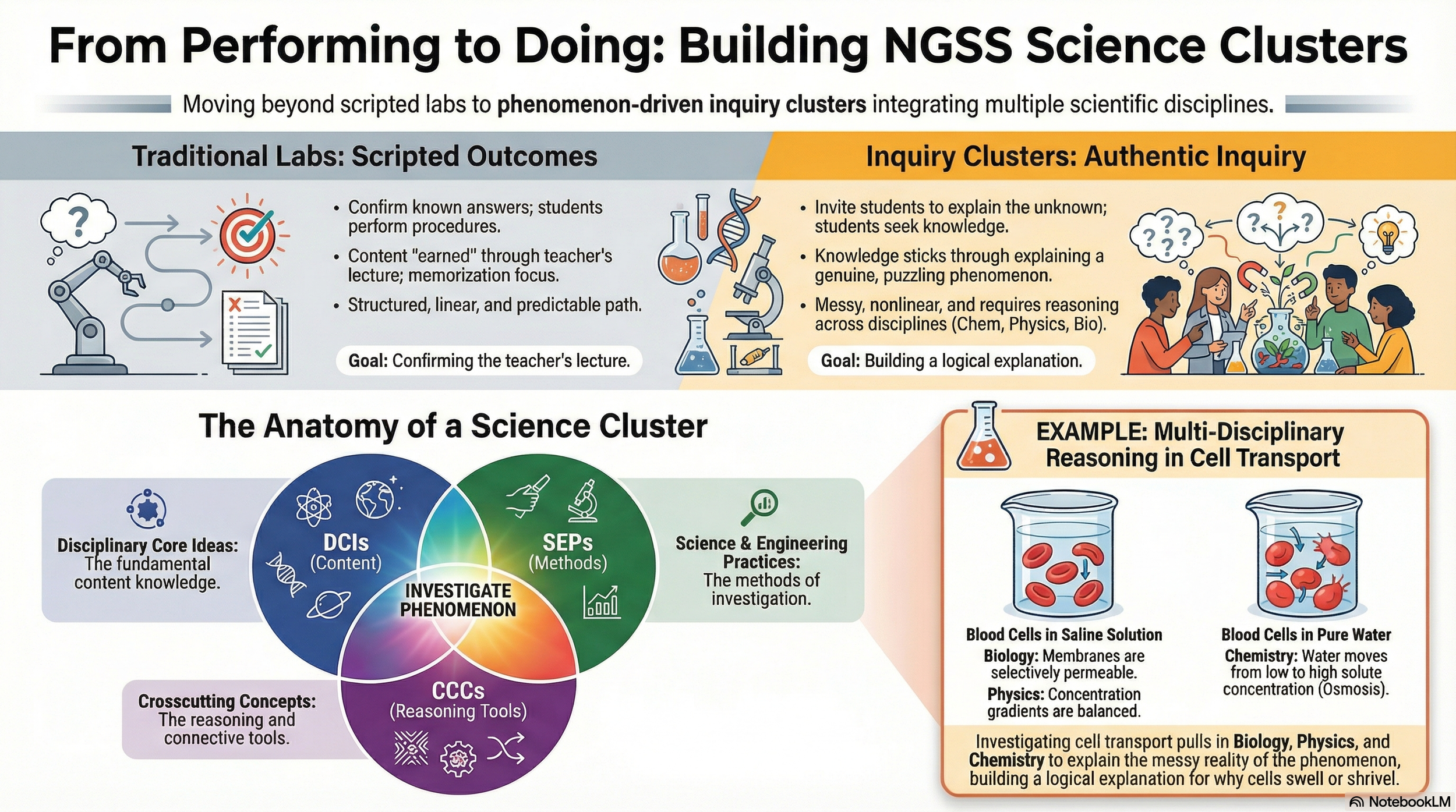
The traditional lab sidesteps this complexity by scripting everything. Students follow procedures, record expected results, and confirm what the teacher has already told them. It looks like science, but it isn't. Most teachers who have done this for years already sense something is missing, which points to the fundamental difference cluster-aligned instruction aims to address.
A Cluster is a Guide
The difference between a cluster-aligned investigation and a traditional lab isn't structural; it's intentional. Both can have procedures, data collection, and questions. What separates them is whether students are being led to a predetermined result or genuinely invited to explain something they don't yet understand.
A traditional lab is written around an answer. The phenomenon is chosen because it reliably produces the expected outcome; the procedure efficiently gets students there; and the questions confirm they arrived. There is a place for confirmation in science education, but it isn't inquiry. Students generally know it isn't. They are performing science, not doing it.
A cluster, in this context, is a purposeful grouping of interconnected scientific concepts, practices, and crosscutting themes focused on investigating a phenomenon. Unlike a traditional lab, which is structured around known outcomes, a cluster frames learning around a central, challenging question. The phenomenon selected does not yield to a simple explanation—students must use reasoning to make sense of it. The CCCs and SEPs are not just organizational labels; they are essential tools students draw on as the investigation requires crossing disciplinary boundaries. For example, Cause and effect are fundamental both in biology and physics; Constructing Explanations is needed whether students analyze a cell membrane or a concentration gradient. A cluster prompts students to seek out content because they need it to build an explanation, not simply because the topic appears next on the syllabus.
The Example of Cell Transport
Taught traditionally, cell membrane transport becomes a classification exercise: students learn the mechanisms, memorize the conditions that govern each one, and fill in a chart. The content is covered, but whether it is understood is a different question.
Anchor it differently. Show students three beakers. A red blood cell in salt water shrivels. The same cell in pure water swells until it bursts. In saline at the same concentration as blood, it stays intact. Ask them why.
That question has no vocabulary answer. Students have to reason about what is moving, why it moves, what stops it, and what the cell is trying to accomplish. The biology pulls in physics; particle motion and thermodynamic equilibrium. It pulls in chemistry: polarity, molecular size, and membrane permeability. When students model what they think is happening with a dialysis tube, they are doing engineering, asking how well this physical system represents a biological one, and where the comparison breaks down.
The relevant standards are HS-LS1-2, which models how systems of cells perform essential functions, including material movement, and HS-LS1-3, which focuses on feedback and homeostasis. The disciplinary core idea, LS1.A, tells us that membrane structure determines function; selective permeability is tied to the physical and chemical properties of both the membrane and whatever is trying to cross it.
The DCI gives students the content they need. The SEPs give them a method for generating and using evidence. The CCCs provide a way to organize reasoning when the investigation crosses disciplinary boundaries. A student working through this isn't following a predetermined path. They are choosing which question to pursue, which CCC lens is most useful at a given moment, and which SEP helps them generate the evidence they need. The teacher's job is to design an experience in which those choices are real, and the investigation holds together regardless of which direction the reasoning takes them.
The Design Problem
Building investigations this way is real work. For a single topic, it is demanding; across a full course, it is unsustainable without a framework to work from. Not a script, but a set of design questions a teacher can return to consistently.
What is the phenomenon, and what genuine questions does it raise? Which discipline anchors the investigation, and which others will explanation naturally draw in? Which CCCs will students need as reasoning tools? Which SEPs will generate the evidence required for a complete explanation? What does a finished explanation look like when a student has produced it?
Answering those questions across every topic in a course is where teacher creativity and the demands of the standards must meet. Most teachers navigate this alone, rebuilding the design logic from scratch each time. A design template doesn't solve that problem completely, but it gives it some shape.
Time
Forty minutes is not enough time for genuine inquiry—neither is ninety. Inquiry does not resolve in a single sitting; it accumulates across sessions, each one building on the last without definitive closure.
Students will resist this. They want the right answer; they have been trained to believe that is what school is for. But inquiry is more about the quality of the question than the correctness of the answer, and content knowledge in this model is something earned through the process of explanation, not distributed in advance as scientific trivia. Knowledge that a student needs to answer a question they are genuinely asking tends to stick. Knowledge handed over before the question exists tends not to.
Designing for this requires care. An open-ended investigation without structure produces frustration, not understanding. The goal is an experience where real thinking is both possible and necessary, where content becomes useful rather than merely preparatory, and where not having the answer yet is a normal condition—not a sign that something has gone wrong.
The standards describe what that learning should look like. Teachers bring creativity, subject knowledge, and an instinct for what their students need. What is often missing is the structure that holds those things together. That is the work Syzygy Science is taking on: a design template that brings standards, genuine student experience, and teacher creativity into alignment, not to make inquiry tidy, but to make it teachable. The mess is part of it. The template is about building a space that can hold that mess without losing the thread.
---
If you want to work through the design process before the template is ready, or have questions about cluster-aligned instruction for your own courses, please make a comment below. This series continues.
