Jeffrey Mann Jeffrey Mann

NYSSLS Science Clusters: What They Are and How They Actually Work in the Classroom

At Syzygy Science, I am developing a new series of lab book templates for secondary science courses, including Non-Violent Forensic Science and Regents Physics. Creating meaningful labs requires more than simply addressing what students learn; it involves considering how they are expected to reason, investigate, and demonstrate understanding under NGSS and NYSSLS. The science cluster model is central to this process, yet its practical purpose can be obscured by unfamiliar terminology. This article is the first in a series designed to clarify what clusters are, why they matter, and how they can inform the design of labs that reflect authentic scientific practice.

When teachers first encounter the New York State Science Learning Standards, the concept of science clusters can sometimes feel more confusing than clarifying. While terms like Physical Science, Life Science, Earth and Space Science, and Engineering are familiar, in these standards they signal a genuine shift in how we are asked to teach—and how students are meant to think. To use clusters effectively, it helps to understand what they truly represent and what they do not.

Science clusters, as defined by the New York State Science Learning Standards, are not courses, tracks, or isolated silos. Rather, they serve as disciplinary perspectives that describe the kind of scientific thinking students are engaged in at a particular moment. The objective is not to divide science into separate compartments, but to encourage instruction that reflects the integrated and dynamic nature of scientific knowledge as it is developed and applied.

A common question follows quickly: Are clusters an instructional model? An assessment tool? A curriculum structure?
Clusters are not, by themselves, instructional models, assessment tools, or curriculum structures. Instead, they function most effectively as a framework for planning and reflection—a means of clarifying which scientific domains are engaged during an investigation and for what purpose.

One of the clearest ways to see this is through biology.

Using Biology to See Cross-Cluster Integration

Life Science is frequently taught as a distinct subject. However, nearly every meaningful biological investigation relies on physical mechanisms, environmental context, and engineered methods. The NYSSLS cluster structure makes these interdisciplinary connections explicit rather than leaving them implicit.

Consider a standard biology topic: cell membranes and diffusion. At first glance, this appears to live squarely within the Life Science cluster. Students study membrane structure, transport proteins, and the role of diffusion in maintaining homeostasis. These are clearly biological ideas.

However, when students are asked why diffusion occurs, the investigation necessarily extends beyond biology. Explaining diffusion requires an understanding of Physical Science concepts such as particle motion, concentration gradients, and temperature effects. Determining which molecules can pass through membranes draws on Chemistry, including properties like polarity and solubility. Modeling diffusion with agar cubes or dialysis tubing engages Engineering and Technology by prompting students to evaluate how well a model represents a biological system. Considering environmental variables—such as salinity, water availability, or temperature—incorporates Earth and Space Science into the analysis.

Studying the cell membrane and diffusion leads naturally to other content areas.

Nothing about the lesson has changed. The question is biological, but the explanation is integrated.

This perspective helps clarify the structure. Life Science anchors the concept, Physical Science explains the mechanisms, Earth and Space Science provides the context, and Engineering offers the tools for investigation. Rather than competing, the clusters work together—each providing a unique lens that enriches students’ understanding.

What the Clusters Are—and What They Are Not

This example highlights a key point that is often overlooked: clusters do not dictate lesson structure. Teachers do not need to “switch clusters” mid-class or ensure all four are present in every unit. Instead, clusters describe the type of scientific reasoning students employ as they work through a problem.

Used this way, clusters serve several important functions:

  • During lesson planning, they help teachers clarify the scientific grounding of an activity.

  • During assessment, they help articulate what kinds of reasoning students are demonstrating.

  • At the curriculum level, they support coherence by showing how investigations build across disciplines rather than remaining isolated.

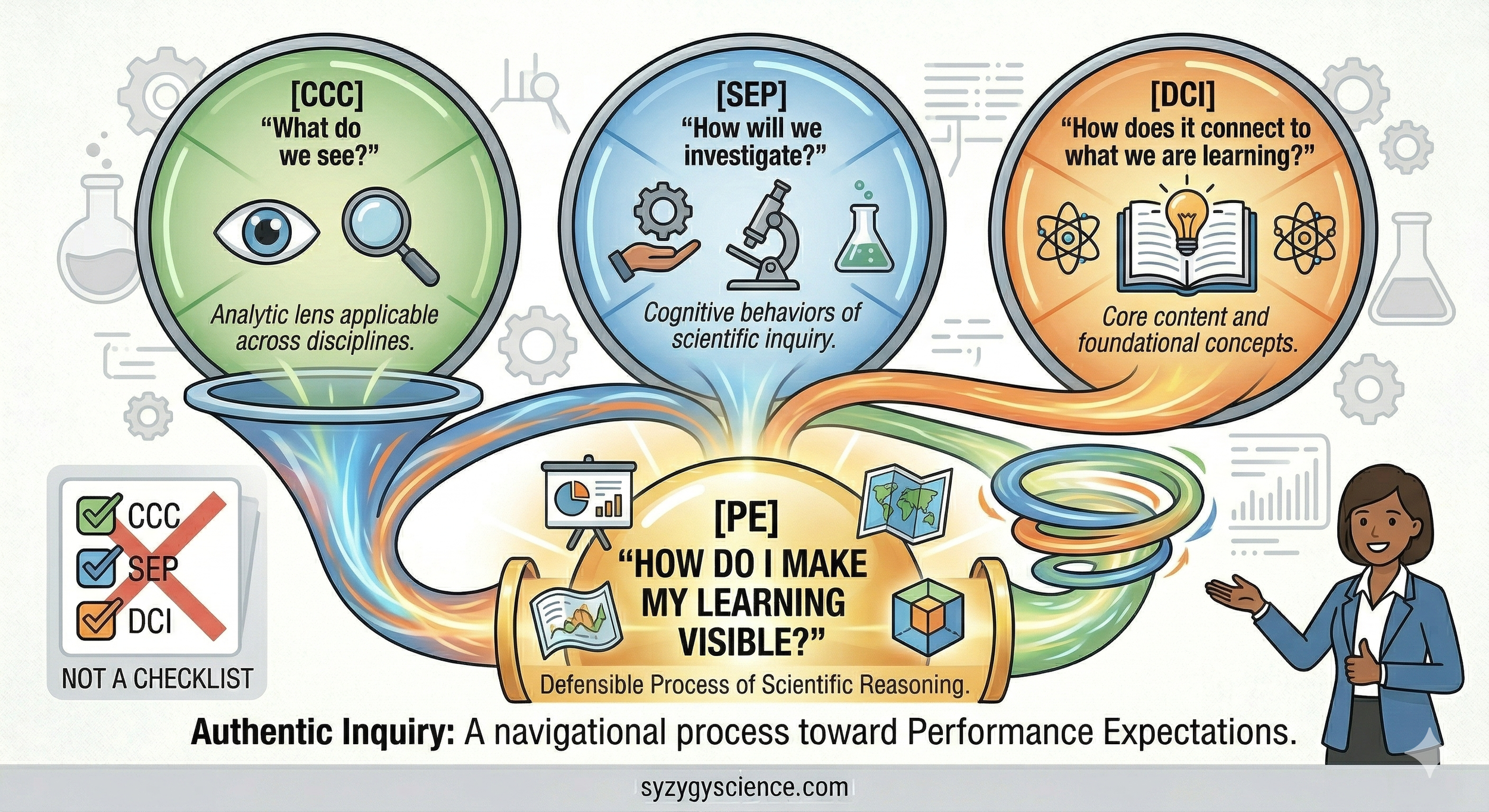
Clusters do not prescribe pedagogy. They are not a checklist for compliance or an instructional script. Integration is not something teachers add artificially; it is an aspect they recognize and support through intentional design.

Why This Matters

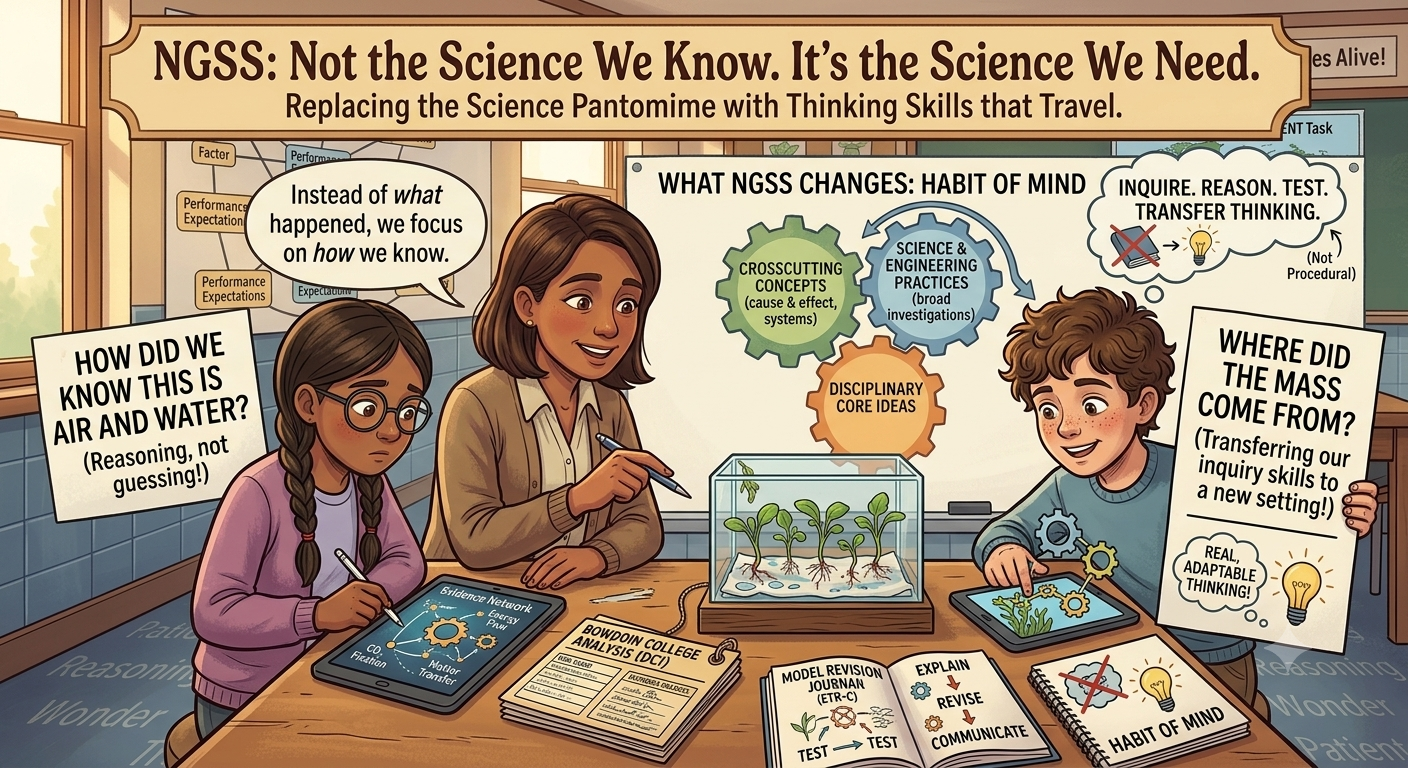
The NYSSLS cluster model reflects a broader shift in science education—from isolated content coverage toward explanation, evidence, and systems thinking. Real scientific problems are not organized by discipline, and effective science instruction reflects that reality. Clusters provide a shared language for describing this integrated approach.

When teachers understand clusters as lenses rather than boxes, biology no longer feels disconnected from chemistry, physics, or Earth science. Investigations become more authentic, reasoning becomes more rigorous, and students gain a clearer picture of how science actually works.

In the next part of this series, we will step back from classroom examples to examine the broader paradigm shift behind the cluster model—why NYSSLS emphasizes integration, scientific practices, and applied reasoning, and what this means for designing labs, units, and entire courses.

Read More
Jeffrey Mann Jeffrey Mann

Evidence First: A Non-Violent Approach to Forensic Science Education

I am beginning my next curriculum project, a non-violent forensic science curriculum, after teaching forensics for the first time during the 2024–25 school year. Sharing the classroom with students who were curious, creative, and sometimes apprehensive reminded me that what we teach is as much about people as it is about science. While the subject naturally engages students, I found that many existing resources relied on dramatization and sensational details rather than the science itself. My goal became to design a course where student interest is driven by evidence, uncertainty, and reasoning—not by shock or spectacle. This required rethinking how violence, narrative, and human elements are presented in the classroom. The result is an approach that treats forensic science as applied science first, allowing narrative to emerge from analysis rather than lead it.

Non-Violent Forensics: Teaching the Science Without the Sensation

Forensic science occupies a complicated space in schools. I’ve seen the spark in students’ eyes when they start connecting classroom concepts to real-world mysteries, but I’ve also watched them hesitate when faced with graphic or sensationalized content. It is one of the most engaging applications of biology, chemistry, and physics available to students, yet much of the curriculum borrows its tone from television and true-crime media. Violence and dramatization are often treated as essential features rather than contextual realities. Teachers must balance student curiosity, institutional caution, and the responsibility to teach real science effectively.

A non-violent forensic science curriculum does not avoid crime, nor does it soften the science. Instead, it makes a deliberate shift in emphasis—from violent acts to the scientific analysis of evidence. The focus shifts from who was harmed to what patterns exist, what data can be collected, and what explanations are supported by that data. In this model, a crime scene functions as a constrained system for investigation, not as a narrative built around suffering.

This shift matters because much of what is marketed as forensic science was not designed for classrooms. Many resources assume mature audiences, embed science within storytelling, and rely on shock value to maintain interest. I’ve spent hours poring over resources, wrestling with what’s appropriate or meaningful for my students. Teachers are often left to edit content on the fly, define boundaries without guidance, and decide what is “too much” in isolation. The result is inconsistency and, in many cases, avoidance of otherwise valuable scientific investigations.

Forensic science works best in schools when it is treated as applied science, not as a genre of crime. Motion, forces, diffusion, material transfer, and system interactions become the objects of study. Evidence is compelling because it reveals how systems behave under specific conditions, not because it is linked to dramatic events. Questions shift accordingly: What variables influenced this pattern? How reliable is the data? What alternative explanations are possible?

Violence remains part of the real-world context, but it is not the instructional focus. A non-sensational approach acknowledges harm without centering it. System-based investigations—such as illegal chemical disposal, arson framed as property damage, or theft—generate authentic forensic evidence without relying on bodily injury or trauma. Human elements are present but are treated analytically rather than narratively. Suspect profiles function as evidence-based constraints, not as dramatic biographies, and conclusions are framed probabilistically.

This approach also applies to student-created investigations. In professional forensic work, narrative does not initiate analysis—it emerges from it. When students design their own scenarios, I encourage them to think like scientists first, not storytellers. They begin with a scientific objective and a set of defined evidence types. Narrative appears only after evidence is examined, as competing explanations are tested against the data. Creativity is intentionally constrained so that students design analyzable systems rather than stories.

When forensic science is taught this way, it no longer depends on spectacle to sustain interest. Students engage with uncertainty, evidence, and explanation—the same intellectual work that defines science across disciplines. A non-violent forensic science curriculum is not about denying reality; it is about teaching students to engage with it responsibly, rigorously, and with intention.

Read More
Jeffrey Mann Jeffrey Mann

The Materials Gap

Wonder is the spark that lights the way to genuine, lifelong learning—igniting curiosity that endures long after the bell rings. Yet too often that spark fades because the tools teachers need to sustain inquiry simply aren’t there. National reviews show the depth of the problem: of the science programs EdReports has evaluated, only 17 percent meet expectations for NGSS alignment while 69 percent fall short. A separate survey revealed 96 percent of teachers value standards‑aligned materials, but only 37 percent believe they have them.

This disconnect leaves educators stitching together handouts at midnight and students drifting through disconnected activities that never build toward mastery of the three NGSS dimensions. Science and Engineering Practices (SEPs) become warm‑up tasks, Crosscutting Concepts (CCCs) are too often treated as side notes, and the story of science is lost in the shuffle.

Syzygy Science is closing that gap by designing resources that put the framework—not the filler—first. Every forthcoming unit and lab begins with a real‑world phenomenon, then threads SEPs and CCCs through each investigation so students use the practices to make sense of concepts in context. Our August Biology Lab Manual (30 ready‑to‑teach labs) pairs, for example, protein‑folding models with the CCC pattern of structure and function; our “Living Rivers” project asks students to build and iterate water‑quality models, rooting data analysis and systems thinking in their own watershed.

Because time is a teacher’s scarcest resource, each lesson is field‑tested for a 15‑minute prep window, with formative prompts already mapped to the relevant practice and concept. The result is continuity that survives beyond a single “wow” moment and cultivates durable scientific habits of mind.

If your curriculum cupboard feels bare, join our pilot list or download the first sample lab next month. Let’s replace the materials gap with materials that work.

Read More
Jeffrey Mann Jeffrey Mann

A New Chapter at Syzygy Science: Reliable Resources You Can Trust

It all begins with an idea.

At Syzygy Science, we’ve always believed in bringing real-world science into classrooms. Today, we’re excited to launch a new site—and a new era—that makes that mission even more tangible.

This site refresh isn’t just a new coat of paint. It’s a reflection of where we’re going: deeper into curriculum development, stronger in our partnerships, and more committed than ever to providing teachers with what they need to teach science effectively.

We’re proud to introduce two main offerings that will shape Syzygy’s next chapter:

  • Curriculum Services: Custom curriculum writing and NGSS-aligned support for districts, nonprofits, and mission-driven companies who want to see their educational ideas make it to the classroom.

  • NGSS Resource Library: A growing collection of ready-to-teach lab books, designed with clarity, ethical care, and explicit standard alignment in mind.

We’re starting strong with three cornerstone products, all in development:

  1. A Non-Violent Forensics Curriculum
    Investigations that center healing, critical thinking, and scientific rigor—without the gore or sensationalism.

  2. NGSS Biology Lab Book
    Thirty labs that tie life science practices to real phenomena, step-by-step, with teacher support built in.

  3. NGSS Physics Lab Book
    Hands-on activities for motion, energy, and systems thinking—crafted to support inquiry and alignment in tandem.

These projects are more than just resources; they are a valuable asset. They’re a promise: that science education can be rigorous, relevant, and responsive to the real world in which students live.

We look forward to sharing more in the coming months. Stay tuned for curriculum previews, lab prototypes, and behind-the-scenes glimpses into how these resources are built.

If you’re a district, school, or organization looking to bring your instructional ideas to life—or just a curious teacher ready for new tools—we’d love to talk.

Here’s to building what science education can be.
The Syzygy Science Team

Read More