
The Tool Can't Think for You
What defines advanced technology?
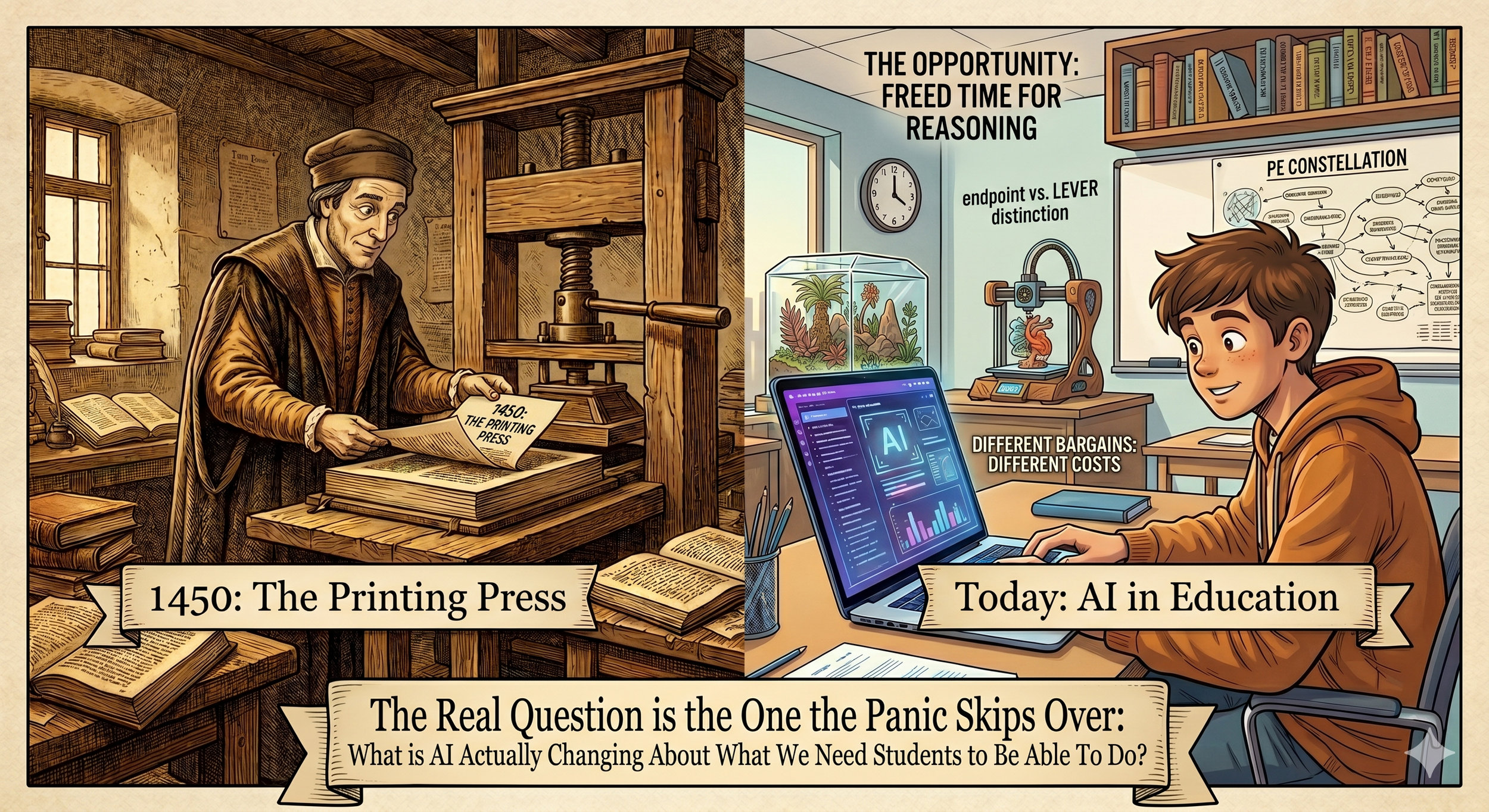
I have been reading a lot about AI in education, and I think there is a point being missed. AI is a technology, much like other technologies before it. The conversation right now treats it as something unprecedented, a threat to learning itself, and the response has mostly been defensive. Schools ban it, detection software hunts for it, assignments get rewritten to outrun it. All of that treats the arrival of the tool as the problem. The arrival is not the problem. The tool is here, students are using it, and it is not going away. The real question is what AI is actually changing about what we need students to be able to do.
We have answered questions like this before. When the printing press spread through Europe in the decades after 1450, it did not just make books cheaper. It changed what a person needed to carry in their own head. Before the press, knowledge lived in memory and in the few manuscripts a person might ever touch, so holding things in mind was the whole of being learned. A scholar was someone who could and did memorize. Once text became abundant, that stopped being true. The worry at the time was real, that easy access to books would make people lazy, that they would stop committing things to memory and lose the discipline learning required. They were not entirely wrong. People did stop memorizing the way they once had. But learning did not end. It became more accessible. The old barriers had been access to teachers, access to manuscripts, and the limits of what any one person could hold in memory. The press lowered all three at once, and in doing so it offered multiple gateways to scholarship.
It is fair to say AI is more than a faster printing press. It does not just store and deliver knowledge, it processes and connects it, and it produces reasoning that looks like the thing we want students to be able to do. But the press is still the right comparison, because it holds where it matters. The press made text abundant and could not make a single person read it, let alone understand what they read. Abundance was never comprehension. AI makes reasoning abundant in the same way, available on demand, and it runs into the same wall. It cannot make a person think. It can hand a student a finished line of reasoning, but it cannot give them the capacity to reason, any more than a full bookshelf could give a person the ability to read. That capacity has only ever come from doing the thing yourself.
This is the question every information technology eventually forces. What do we actually want a student to be able to do? Do they need to hold the facts in memory, or do they need to see the patterns and systems the facts belong to? Ideally a student would do both, carrying the knowledge and the fluency and the understanding all at once. In practice, time is limited and choices get made. Is it more important that a student can recite the steps of a process from memory, or that they can recognize what the process implies and where it breaks down? For some students and some professions the answer leans one way. For others it leans the other. The press did not remove the need to think. It changed which kind of thinking mattered most, and it forced a question about priorities that had been easy to avoid when knowledge was scarce enough that simply having it was the achievement.
AI sharpens this choice rather than settling it. The facts are cheap now, retrievable in seconds, which eases the old pressure to spend class time drilling them. That opens room for the higher-order work the drilling was always meant to serve, the reasoning and the application that are harder to teach and matter more. The opportunity is real, and it is the most exciting thing about the tool. It also asks something of us. The freed time only becomes reasoning if we design for it. Hand the whole task to the tool and the time fills with answers instead of thinking. Used well, AI clears space for the kind of work we never had enough time for. That is the choice in front of us, and it is a better problem to have than the one we had before.
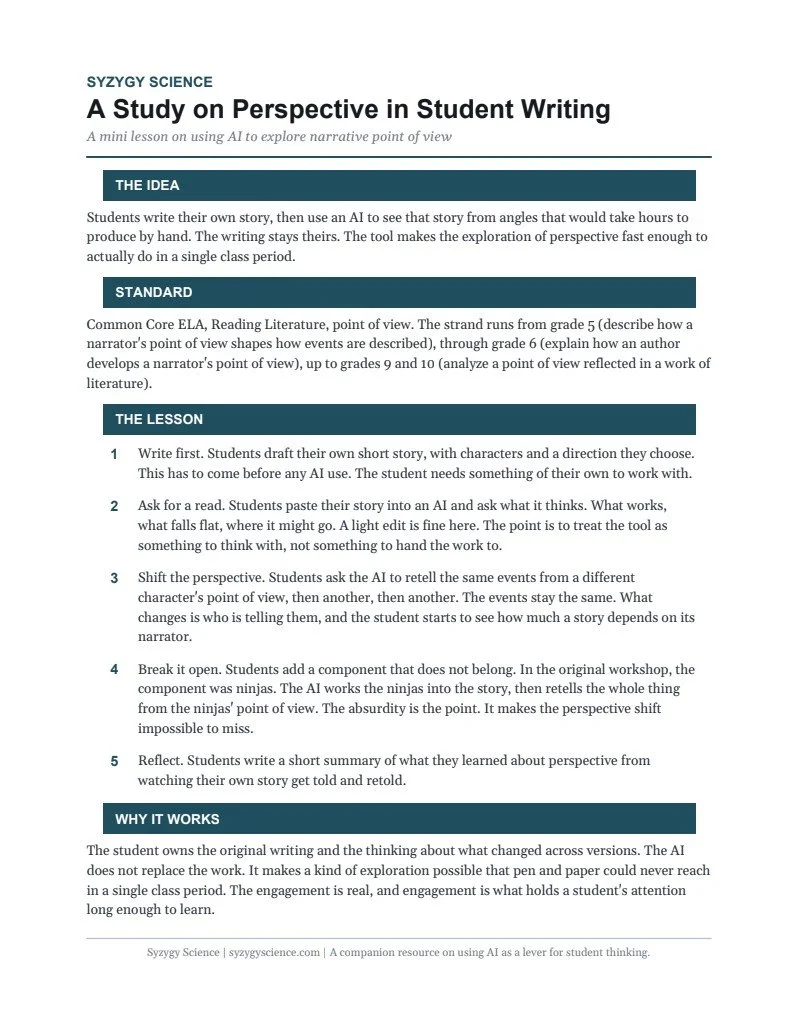
What separates a useful application of AI from a harmful one is how the task is built. There is a real difference between using AI as an endpoint and using it as a lever. Consider a writing lesson built around perspective. A student writes their own short story first, so the composing and the ideas are genuinely theirs. Then they load that story into an AI and use it to explore the story from angles that would be impractical to reach by hand, retelling the same events through different characters and even working in a component that does not belong, just to see how far perspective can stretch. The writing stays real. The tool makes a deeper kind of work possible.
Perspective Mini Lesson
I recently had a student who had come from Hungary, where she had taken advanced physics in high school, including quantum and particle physics. I was teaching a mechanics class, the kind of course that deals with force, momentum, and collisions, the foundational material. She could speak fluently about ideas that were years ahead of where the class was. On its face that made our system look like it was lagging behind Hungary's. But she struggled with the basics underneath the advanced material, the mechanics she had last studied at a sixth grade level. The gap was not her failure, and it was not a failure of intelligence. It was the predictable cost of a curriculum that chose one thing over another. Hungary prioritized advanced science early, and the price was some of the foundational understanding that usually gets built in the later grades.
This is the bargain every system has to make. We cannot teach everything with perfect fidelity, so we choose. That is what standards are for. They are the choices a community agrees to make together, the shared decision about what matters enough to guarantee and what gets left to chance. Hungary made different choices than we do, and got different results. Neither is a failure. They are different bargains with different costs.
If standards are how we make these choices, then the question is not whether to choose but how well the choosing is done. The better standards over the last fifteen years have made a particular bet, that the thing worth guaranteeing is not how much a student can hold but what they can do with it. The C3 Framework reorganized social studies around an inquiry arc, where students develop questions, weigh sources, and take informed action instead of reciting dates. Common Core math paired its content with eight standards of mathematical practice, asking students to make sense of problems and to construct and critique arguments.
The difference is in the architecture. Common Core kept its content and its practices as two separate lists, so a teacher can deliver the content and quietly skip the reasoning, and many do. NGSS refused to leave that separation. It built the dimensions together so that content, practice, and the concepts that connect them cannot be pulled apart. If the goal is genuine inquiry, a multidimensional model is needed, and that recognition is clearest in the framing of the more recent standards. The fault line is not really between subjects. It is between standards that treat reasoning as part of the structure and standards that leave it as a column someone can choose to skip. This is why the distinction matters more now than when these standards were written. When a tool can produce the content on demand, a standard that only asks for content is asking for the thing the tool already does. The standards that built reasoning into their structure are the ones still pointing at something worth teaching, the part a student has to do for themselves.
The entire structure of education is built on the acquisition of knowledge, the assessment of knowledge, and the regurgitation of it on command. Technology has changed the calculus underneath that model. Without these tools, you have to hold knowledge yourself, in memory or close at hand. The book, the internet, and now AI remove that necessity. Acquisition still matters, but it is no longer the hard part, and it is not what students are missing. What they are missing is the ability to use what they know, to reason with it and apply it to situations no one prepared them for. Horace Mann assumed that capacity would emerge on its own, that knowledge and reason were coemergent. Modernity has shown us it does not work that way. My student from Hungary had the knowledge and could not reason from it, because reason does not come from knowledge. Reason comes from practicing reason.
The criticism you hear most is that AI does the work for the students. It writes the essay, runs the analysis, answers the question the student was supposed to wrestle with. The complaint is fair, and the work really is being done by the machine. But it points somewhere most people do not follow it. If a tool can do the work and the student still gets credit for learning, then the work was never measuring learning. It was measuring whether a student could acquire knowledge, hold it, and produce it on demand, and a machine does that better than any student ever could. The thing we built school to do is the thing a tool can now do for us, which forces the question of what school is for. There is a long list of things AI cannot do. It cannot make a student care. It cannot make a student invest in a question, cannot make them literate, cannot turn them into a person who thinks. It can produce reason as a product, but it cannot create reason in a person. That only comes from the person doing it themselves.
This is the contradiction teachers are handed. They are required to evaluate the retention of knowledge, which AI has made an antiquated thing to measure. The system still asks them to produce memorizers when what it needs is thinkers.
This does not mean abandoning the fundamentals or pretending the tools are not in the room. The tools are in the room, and a student who refuses to use them is not better prepared, only slower. The work is to use them well, to let them carry the parts that no longer need to live in a student's head and to spend the freed effort on reasoning, on application, on the practice that actually builds understanding. There will be gaps. A student will lean on the tool and skip something they turn out to need. That is not a failure of the approach. It is a normal cost of it, and it is fixable. You find the gap when the work exposes it, and you go back and fill it in. The foundation does not have to be poured all at once, in advance, on the chance that it might someday matter. It can be built where and when the reasoning needs it.
The better version of this is when the student notices the gap before anyone points to it. They hit a place where their reasoning runs out, and instead of stalling they ask what the assumption underneath it is built on, why the thing works the way it does. That question is the engine of real inquiry. It is also the whole logic of phenomenon-based learning. You start with the thing in front of you, you examine what it is and how it behaves, and you work backward into the understanding that explains it. That is close to the opposite of the model most of us were trained in, where the student follows the lecture, takes the quiz, runs a lab whose outcome was decided in advance, and repeats the textbook back on the summative.
The tools do not earn blind trust. AI is fallible. It will produce reasoning that looks clean and is wrong, and a student who accepts that output without question has only swapped one authority for another. Trading a lecture you do not interrogate for an AI you do not interrogate is not progress. The skepticism is the work. The student has to ask where the reasoning came from and whether it holds, which is the same discipline good inquiry has always demanded. That puts the real questions back where they belong. Where does the motivation come from, the student's own curiosity or the points attached to the task? Where does the knowledge come from, and is it sound? And what is the goal of the whole exercise, reasoning or regurgitation? If we get those answers wrong, the tool just lets us pantomime faster.
If the printing-press comparison and the example of my Hungarian student landed for you, the Framework Overview goes further into how the Syzygy Cluster Design Process puts content, practice, and reasoning together so a tool can’t substitute for the thinking. Get the Framework Overview PDF and a sample lesson built on it.
Or skip straight to building one: the free Inquiry Builder generates a complete phenomenon-based lesson plan from your grade level, topic, and materials in a couple of minutes.
