
This Is Not Evil. (Mostly.)
Building an AI lesson generator as a science teacher.
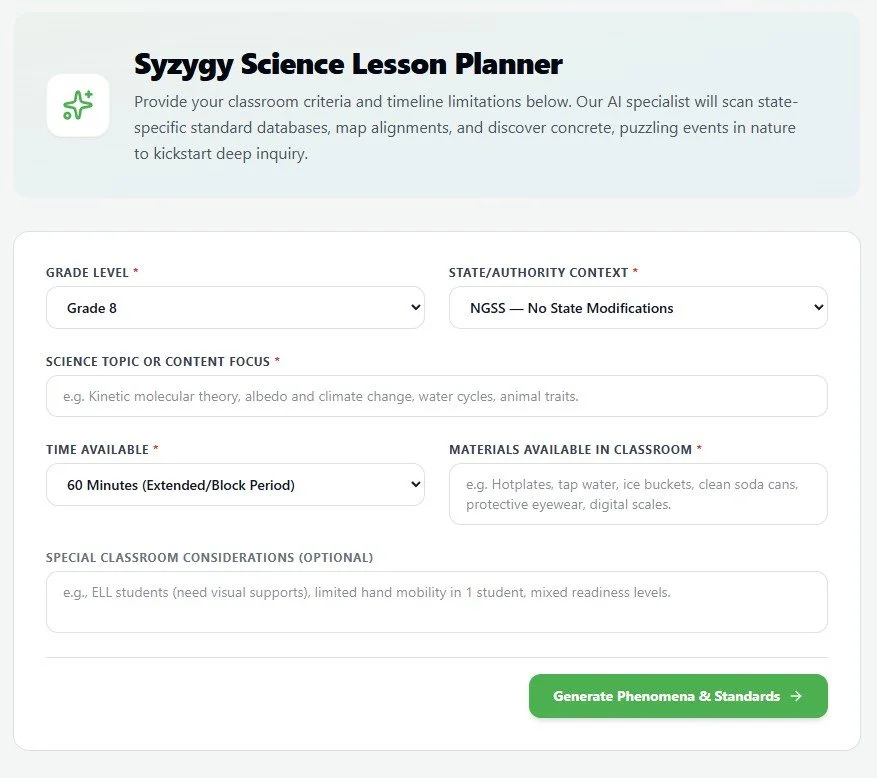
This is the syzygy Science Inquiry Builder Lesson Planner. A tool to get teachers off the mat in difficult moments.
I have spent the last year writing about the limitations of artificial intelligence, the danger of outsourcing thinking, and the importance of genuine inquiry in the classroom. Then I built an AI lesson generator. I understand how that sounds, and I want to explain how I got there. A year spent warning readers about the seductive ease of AI, and then I turn around and build a tool that makes things easier. I am aware of the irony before anyone points it out.
The concerns that shaped those earlier posts have not gone away. Like any tool, AI can be misapplied, and when it is, it returns results that look finished but are not accurate, in ways that can be hard to catch precisely because they look so polished. It tends to smooth over rough edges and flatten the nuance that real instructional thinking depends on. Those problems are real, and they sit alongside an equal potential for genuine solutions.
At the same time, there was a problem I ran into constantly, one that most teachers will recognize. A lesson is planned, sometimes built over weeks or months, and then an assembly runs long or some other unforeseen circumstance disrupts the timeline. The lesson that took that much preparation is suddenly sidelined, and a solution has to come together quickly, with whatever resources happen to be on hand, often outside the timeframe a teacher is used to working in and under conditions that make careful planning impossible.
In those moments, it is difficult to produce quality material. I have personally spent hours searching online, paid for expensive TPT resources, or simply winged it, and that approach sometimes works and sometimes does not. This tool is meant to give teachers a starting place instead, built from their grade level, the time they have, the topic they want to cover, and most specifically, the materials they actually have on hand. That can be anything: a bar of soap, a length of string, a toothpick, whatever is sitting in the room. The generator takes those constraints and tries to build a lesson around them. It gives you a starting place, and if that starting place works, it gives you a complete lesson.
The more time I spent on this, the clearer it became that my skepticism about AI was never really about the technology itself. It was about what happens when generated answers get mistaken for understanding, the same concern that sits underneath what I have called Science Pantomime, going through the motions of inquiry without the thinking inquiry actually requires. A finished lesson plan does not guarantee a good lesson, just as a completed worksheet does not guarantee that learning happened, and the same gap exists with anything AI generates for a classroom. A tool is only useful if it helps a teacher think more clearly about the choices in front of them, not if it lets a teacher think less.
I think of this as an experiment rather than a finished product, which is closer to how I would want a scientist to treat a new tool. Scientists do not worship their instruments, and they do not avoid them out of suspicion either. They test them, look for where they fail, compare what they produce against what they expected, and adjust their thinking accordingly. That seems like a reasonable way to treat artificial intelligence in a classroom too, and it is the spirit in which I am opening this tool up for other teachers to try.
It is unfinished, and it will make mistakes. Some of what it produces will be genuinely useful, and some of it will be something you would never bring near your students, and both outcomes tell me something I need to know. If you want to try it, give it a standard you have struggled to teach, or a lesson that never quite worked, or the actual contents of your supply cabinet, and let me know where it holds up and where it falls apart.
Every new tool changes what we hand off and what we keep for ourselves. The question with AI in the classroom was never really whether to use it. It is which parts of the planning still need to come from the teacher, and that is the question I am hoping this experiment helps answer. You can find the tool linked as Builder on the website, and I would genuinely like to know what you find when you try it. It is also a question I am picking back up soon in a piece looking more closely at what AI changes for students, teachers, and administrators, so consider this the practical half of a conversation the next post will continue.
