
Three Dimensions, One Target
Integrating Three Dimensions Toward a Unified Learning Target
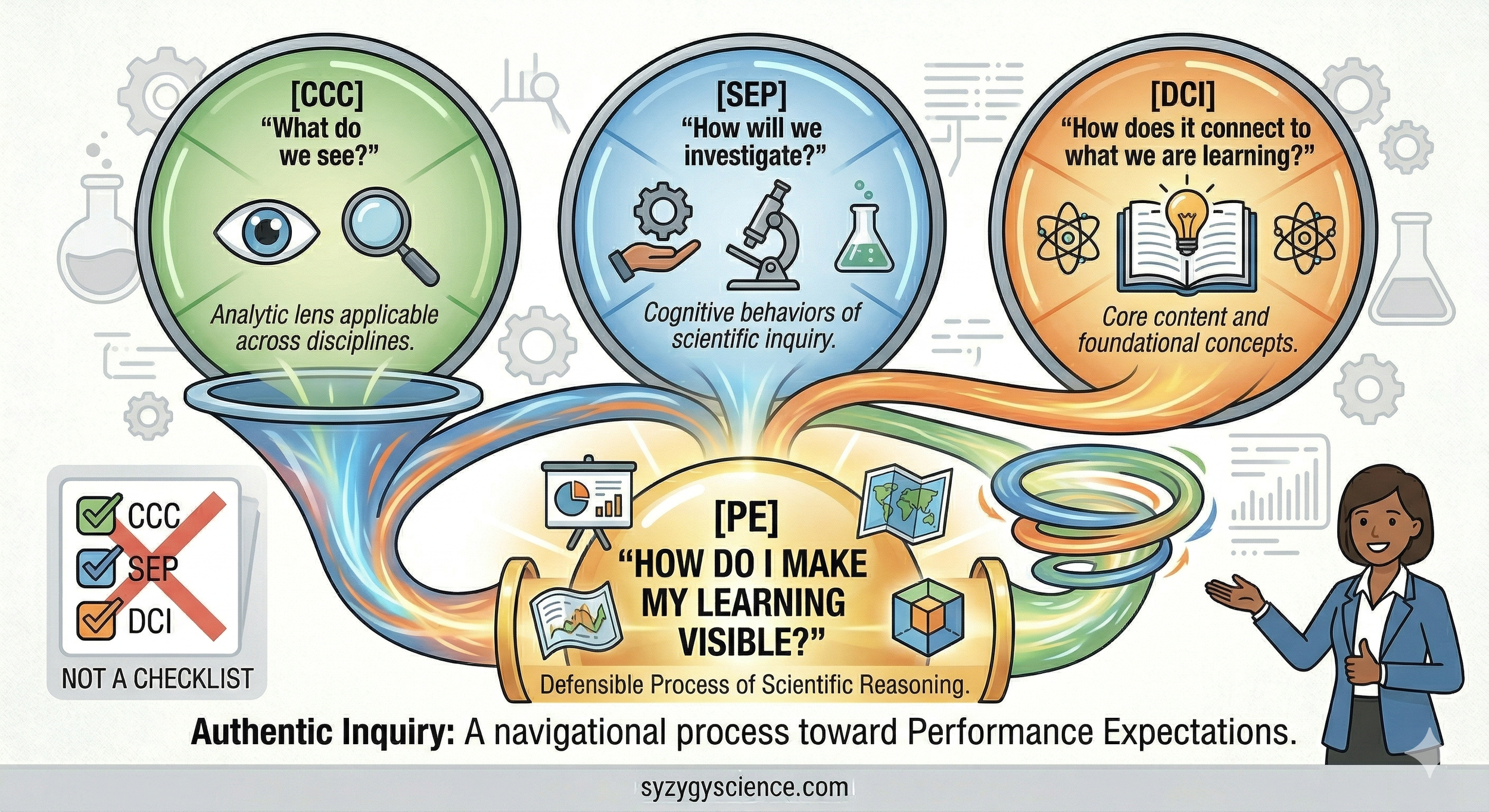
Authentic inquiry involves the combination of the three dimensions of NGSS. Observation, in the form of Crosscutting Concepts, Investigation, in the form of Science and Engineering Practices, and Content, in the form of Disciplinary Core Ideas.
Educators often first encounter the Next Generation Science Standards (NGSS) as three columns: Crosscutting Concepts, Science and Engineering Practices, and Disciplinary Core Ideas. This presentation can inadvertently reduce the dimensions to a checklist, resulting in instructional challenges. Confusion frequently arises when curriculum materials attempt to retrofit existing lessons to align with NGSS, mapping the three dimensions onto activities not originally designed for this framework. As a result, the dimensions may be perceived as superficial labels rather than as essential elements of the inquiry process within a Performance Expectation. Although this approach is understandable given practical constraints, it risks suggesting that identifying the dimensions is the primary objective, rather than achieving the Performance Expectation, which constitutes the true assessable outcome.
The three dimensions are not intended as learning targets themselves; instead, they represent the processes through which students achieve the actual targets, namely the Performance Expectations. Students attain a Performance Expectation by engaging in authentic inquiry: observing phenomena through a conceptual lens, investigating with scientific practices, and connecting findings to disciplinary knowledge. The relationship between the dimensions and the Performance Expectation is analogous to the relationship between ingredients and a finished recipe. While the dimensions are essential components, the Performance Expectation is the intended outcome.
What Are the Dimensions
Crosscutting Concepts serve as analytical frameworks across all scientific fields. Examples include Patterns, Cause and Effect, Scale and Proportion, Systems and System Models, Energy and Matter, Structure and Function, and Stability and Change. Science and Engineering Practices involve key cognitive behaviors in inquiry, such as asking questions, building models, analyzing data, and arguing from evidence. Disciplinary Core Ideas are central content, chosen for explanatory power across grades, not for covering everything.
Each dimension has value on its own. However, challenges arise when they are treated as isolated targets rather than as interdependent elements that enable authentic scientific inquiry.
Clarifying Performance Expectation Requirements
For educators unfamiliar with the NGSS standard pages, the layout may initially appear disorienting. Performance Expectation statements are prominently displayed at the top, followed by a color-coded table: Science and Engineering Practices in blue on the left, Disciplinary Core Ideas in orange in the center, and Crosscutting Concepts in green on the right. Additional information, including clarification statements, assessment boundaries, grade-band articulations, and Common Core connections, is provided below. The visual emphasis on the three colored columns can create the misconception that these are the ultimate goals, rather than components of the inquiry process that guide students toward the Performance Expectations.
For instance, HS-LS4-2 asks students to explain, with evidence, how natural selection leads to population adaptation. Here, natural selection and adaptation are the Disciplinary Core Idea (DCI). Constructing an explanation from evidence is one of the Science and Engineering Practices (SEPs). The Cause and Effect lens is the Crosscutting Concept (CCC). All three are essential and do not work well in isolation. If separated, the activity may still educate, but it does not meet the NGSS's three-dimensional Performance Expectation criteria.
This distinction holds particular significance for assessment, though not always in the way the framework is commonly interpreted. Crosscutting Concepts, Science and Engineering Practices, and Disciplinary Core Ideas are not intended to serve as scoring rubrics for completed work; instead, they represent the process of authentic scientific inquiry. The Crosscutting Concept shapes students' perspectives on the phenomenon, the Science and Engineering Practice provides investigative tools, and the Disciplinary Core Idea offers the conceptual foundation for interpreting findings. The Performance Expectation demonstrates not only conceptual understanding but also that students have achieved this understanding through a defensible process of scientific reasoning.
Framing Inquiry Through Four Guiding Questions
At Syzygy, the three dimensions are articulated as four guiding questions that students can use to orient themselves during any scientific investigation:
What do we see when we look at the phenomenon? (CCC)
How will we investigate this phenomenon? (SEP)
How does it connect to what we are learning? (DCI)
How do I make my learning visible? (PE)
The first three questions function as navigational aids, while the fourth represents the ultimate goal. A student who can answer only the third question demonstrates content knowledge. In contrast, a student who can address all four questions is actively engaged in scientific inquiry.
For instructional planning, these questions shift the focus from merely covering Crosscutting Concepts to evaluating whether a task genuinely requires all three dimensions to be completed. If students can complete the work through content recall alone, authentic inquiry is absent, and only retrieval is taking place.
This is key: Assess what students do, not what is labeled on the plan. If students need content knowledge, investigative methods, a lens for interpretation, and a way to show their thinking, then the dimensions move beyond compliance. They become signs of strong science teaching. This matches the main NGSS intent.
