
The Syzygy Framework Is Now a Document
Previous posts have outlined the principles behind the Syzygy Cluster Design Process: why treating the three NGSS dimensions as a checklist fails, why Science Pantomime is a design problem rather than a teacher problem, and why open inquiry and PE assessment have to be kept in separate rooms. Those posts focused on the rationale. This one is about the document.
The Syzygy Cluster Design Process Overview, version 9.1, is now a free download. It formalizes the architecture behind every cluster built on this framework.
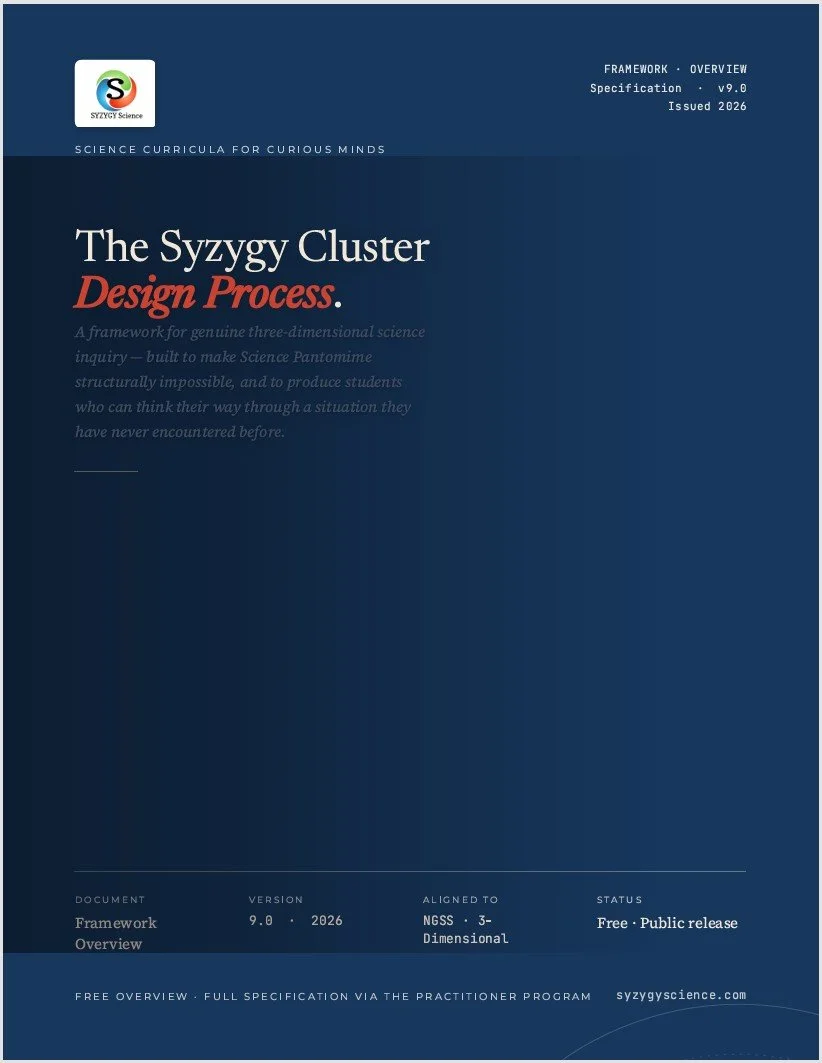
Click to download the Process Overview PDF (free, no signup)
What the document actually contains
The Process Overview is ten pages, organized around seven sections, each one a structural element of the design process.
It starts with the problem: students who perform the motions of inquiry without actually doing it. It maps the four questions a genuine investigator asks onto the NGSS dimensions, names which two belong to the student and which two belong to the design, and lays out the three-stage architecture with the Breakpoint sitting between open inquiry and PE assessment. It explains why conflating those two environments is the single most common way inquiry collapses back into test preparation.
The six design principles follow. They govern every design decision in the framework. A cluster that violates any one of them does not reach students. The document states each principle plainly and gives the reasoning behind it.
Then the eight steps: the sequential protocol that moves a cluster from DCI definition through open inquiry design, the Openness Check, PE assessment task, teacher guide, and post-implementation reflection. The Breakpoint sits between steps five and six.
The document closes with the Openness Check itself: four questions every cluster must answer yes to before it reaches students. Does the phenomenon resist a single obvious explanation? Can the target PE be reached through more than one valid CCC-SEP combination? Would an unexpected result enrich the investigation rather than break it? Does the design require students to produce genuine reasoning, not just correct conclusions? Every No is a return instruction.
Why the Breakpoint matters enough to be in the document
The Breakpoint is the piece of the framework that took the longest to get right, and the piece most likely to be skipped in practice.
During a Syzygy Cluster, the CCC and SEP are student-chosen. Divergent reasoning paths are expected. Scaffolding is present. The scenario students are working in is the phenomenon they have been investigating. Reasoning quality is the primary measure of progress.
After the Breakpoint, all of that changes. The CCC and SEP are fixed by the standard. The student works independently. The scenario is entirely new. Three-dimensional PE achievement is the measure.
When those two environments share rules, the assessment quietly dictates the cluster. Students begin preparing for the demonstration instead of investigating the phenomenon, and the inquiry is over before it starts. The Breakpoint restores each environment's integrity by drawing a clear line between them.
A student who genuinely reasoned during the cluster has everything they need for what comes after. A student who followed a procedure to a predetermined conclusion does not. That gap is what the Breakpoint makes visible.
This is the free version. Here is what is behind it.
The Process Overview covers the high-level architecture. The full specification, detailed design requirements, worked examples, quality gates at each step, and access to the Syzygy-Bot AI design assistant are available through the Practitioner Program.
If you want to see the framework in action, BIO LAB 1: Something from Almost Nothing is coming very soon as a free download. It is a four-day high school investigation into plant mass and matter cycling, built on the full eight-step process. The Breakpoint is explicit in the instructional arc. The Openness Check rationale is in the design notes. It will be the clearest way to see what the framework produces in a real classroom.
