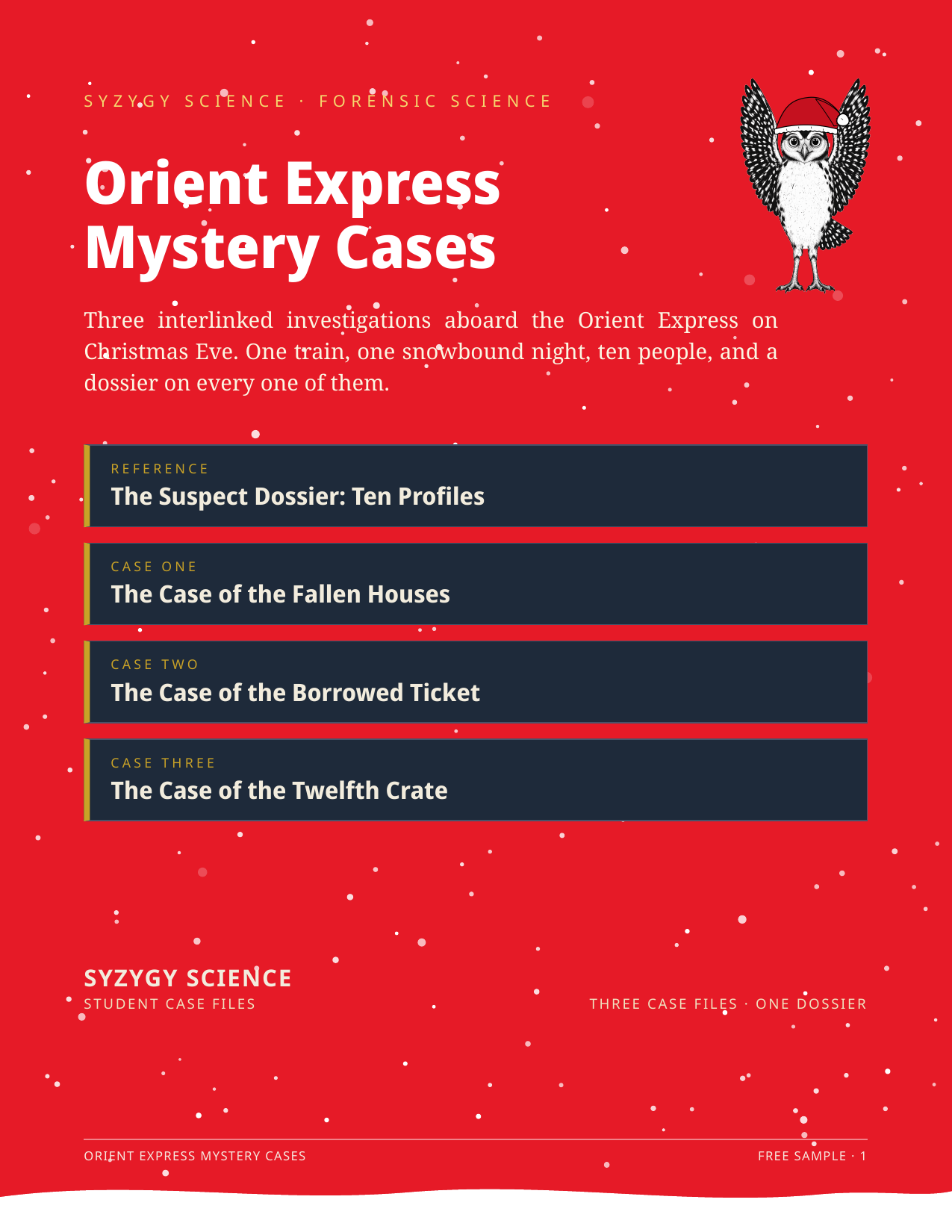
The Orient Express leaves Paris at 7:40 on Christmas Eve and stops in a snowdrift at ten past one in the morning, held there for ninety minutes. By Vienna, three things need explaining: a sabotaged gingerbread competition, a passenger traveling on another man's ticket, and a baggage waybill that is one crate short. This pack gives your class all three cases.
The cases are built for forensic science classes in grades 9 to 12. They share one dossier of the ten people aboard, four railway staff and six passengers. Each profile records the person's fingerprints, DNA, shoe prints, handwriting, the trace evidence their clothing sheds, and what they carried onto the train. Students check the evidence in each case against the same ten profiles, and the dossier work in one case is practice for the next.
The three cases
The Case of the Fallen Houses. The train's gingerbread competition ends with three houses down and the rest standing. The sugar tin holds salt, and every house built from it after nine o'clock fell. Who exchanged the contents of the two tins, and at what hour?
The Case of the Borrowed Ticket. The man in compartment seven travels as Stefan Marek, on Marek's ticket, with Marek's blessing. His signature on the wine list matches nothing in Marek's hand. The case file prints Marek's statement in full, and the statement is one of the records students have to test. Who is the man in compartment seven, and what did the two of them agree to?
The Case of the Twelfth Crate. Twelve crates of glass angels ride in the baggage van, bound for a hospital Christmas tree. The waybill counts eleven, and one figure on it has been redrawn in pencil. Who changed the count, and where did the twelfth crate spend the night?
How a case runs
Evidence is printed as cards, two to a sheet, and a keeper deals each card when a group's questions call for it. The pack holds 44 cards: fifteen for Case One, thirteen for Case Two, sixteen for Case Three. Each case carries a one-page guide that maps the questions students ask to the cards those questions release, and a manifest that lists the full deck. Run a case as stations, with groups rotating through the evidence, or one case at a time with the whole class on the same case. A quick run deals the whole deck at the start, for a short period or a substitute's lesson.
Suspect statements are printed inside the case files, and the teacher edition's solution pages key the statements claim by claim. The solutions rest on converging lines of physical evidence, and each line's innocent explanation is named beside it. Students close a case with a written claim, and the reveal tests the claim against the full record.
What is inside
The suspect dossier: ten profiles, each with fingerprints, a DNA record, trace evidence panels, shoe prints, a handwriting sample, and a carried items list
Student case files for the three cases, with evidence logs for recording each card as it is dealt
The evidence deck: 44 cards printed two to a sheet, ready to cut and laminate
The teacher edition: a one-page If They Ask guide and a card manifest for each case, the two run formats, full solutions, and the claim keys
The combined pack file runs 101 pages.
About the free sample
Case One is listed separately in this store, free. The Fallen Houses comes with its dossier pages and all fifteen of its cards, so a class can run the first case before you spend anything.
Built by a curriculum designer and former classroom teacher.