
The Device Delusion: A Device in Every Backpack
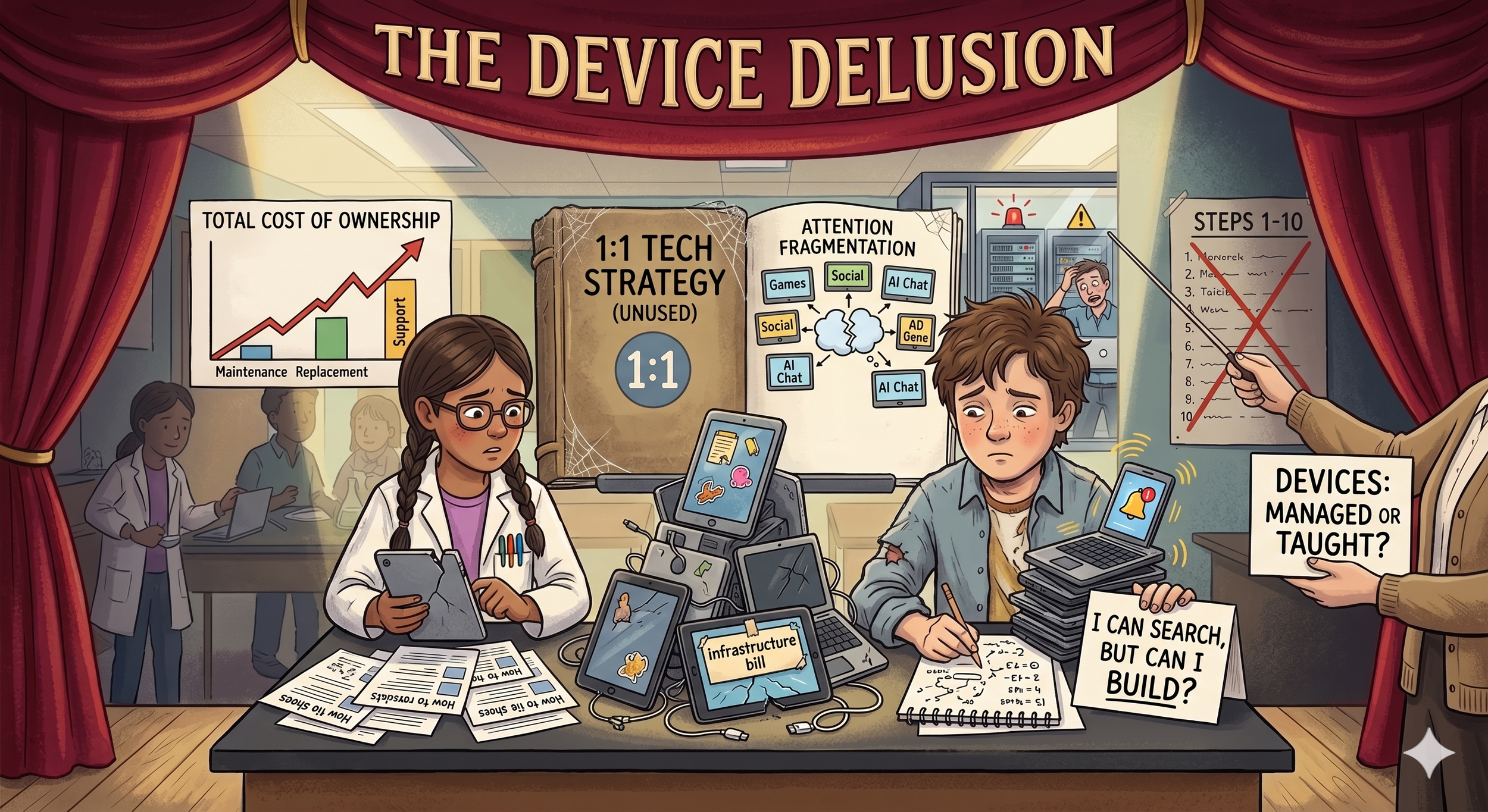
The device delusion mistakes access for outcome. A device in every backpack is not a strategy.
In 1932, Franklin Roosevelt promised a chicken in every pot. The promise worked because it was literal. Hunger was the problem, and a chicken in a pot addressed it directly. The promise of a device in every backpack borrows that same directness. The problem it addresses is real: unequal access to information, gaps in digital literacy, and students without reliable tools for learning falling further behind those with them. Put a device in every hand and the gap begins to close. It is a clean, legible solution to a problem that is genuinely worth solving.
The difficulty is that access and outcome are not the same thing. The New Deal built infrastructure that people used to live. A device in a backpack is infrastructure, too, but what students do with it turns out to matter enormously, and that part is harder to legislate. Districts invested in the devices, the networks, and the rollout. The instruction, the oversight, and the sustained support that would make the investment work received considerably less attention. The gap the program was designed to close did not disappear. In many cases it shifted shape.
What followed is worth examining carefully, because the problems are not incidental. They are structural, and understanding them is the first step toward something better.
The cost is the clearest place to start. The purchase itself is substantial, but it is only the beginning. Devices need to be replaced on a short cycle; batteries fail; software changes; and networks have to be upgraded to handle the load. Support staff becomes part of the baseline rather than an added service. Nearly $200 billion in federal pandemic relief flowed into K-12 schools between 2020 and 2024, and a significant portion went to devices. A 2024 McKinsey survey of more than 480 district administrators found that more than half expected a fiscal cliff in their budgets once that funding expired (McKinsey, "When the Money Runs Out," September 2024). That money is now gone, and districts are discovering what sustaining the infrastructure actually costs without the subsidy. Over time, they are not just investing in learning tools. They are maintaining a system that has to be continuously renewed just to stay in place, and that commitment quietly displaces other priorities.
Effectiveness is less straightforward. Maine launched the first statewide one-to-one program in the country in 2002, giving every middle and high school student a laptop. It was well-resourced, carefully watched, and sustained long enough to generate real data. An independent analysis of outcome data from 2006 to 2013 found little or no measurable impact on test scores in math, reading, or writing, despite a program cost of roughly $11.5 million per year (Bowdoin College, "Are Laptops in Maine Schools Helping Students?", May 2018). If the model did not move the needle in Maine, the burden of proof for scaling it nationally was higher than most districts acknowledged, even with COVID funding that made it easy to say yes. The 2022 Programme for International Student Assessment, which tested roughly 690,000 students across 81 countries, found that moderate device use was associated with better outcomes, but the relationship reversed as use increased. Students who spent five to seven hours daily on devices for leisure scored 49 points lower in mathematics than moderate users, even after adjusting for socioeconomic background (OECD, "PISA 2022 Results," December 2023). Whatever gains appear tend to come from how instruction is structured around the device, which raises the question of how much of the investment is actually necessary.
In the classroom, the more immediate effect is not a clear increase in learning, but a shift in how attention is held. A device on a desk does not wait to be used. It invites interaction continuously, and students move in and out of the task at hand often enough to matter. With AI tools now part of that environment, the issue is no longer just a distraction. It becomes a substitution. A December 2024 study in the British Journal of Educational Technology concluded that ChatGPT use risks promoting what the researchers called "metacognitive laziness," shifting thinking and problem-solving away from students (Fan et al., "Beware of Metacognitive Laziness," December 2024). When a response can be generated and shaped to fit the assignment, the need to stay with the problem begins to fade.
The gap between access and skill is harder to see, but it may be more important over time. Students spend hours each day on devices, yet many struggle with tasks that one-to-one access was supposed to support: structuring a document clearly, organizing data so it can be used, building something that holds together beyond a few disconnected sections. Most of the use settles into searching, copying, and assembling. The presence of the device creates the impression that deeper skills are developing, even when they are not.
Many districts are now moving to restrict device use during the school day, largely due to concerns about attention and mental health. As of early 2026, more than 28 states had enacted phone-free school policies affecting tens of millions of students. School-issued devices sit in an awkward position within that shift. They are more controlled than personal phones, but not fundamentally different in how they function. Students tend to find workarounds faster than schools can close them down, and the same patterns reappear in a different form. The pace of change compounds the problem. Features shift, new tools emerge, and what takes a teacher time to understand can spread through a classroom in hours. On top of that, industry data consistently shows that a significant share of school devices are damaged or out of service at any given time. The daily work of keeping them charged, up to date, and functional is a persistent drag on instruction.
There is a better model that does not require abandoning technology in schools. It requires rethinking where that technology lives. Rather than distributing access across hundreds of devices that are difficult to maintain, districts can concentrate resources in centralized computing spaces within each building. Not occasional-use rooms tucked at the end of a hallway, but well-maintained environments where students go when the work actually calls for that level of capability. High-quality workstations and applied technologies, such as 3D printers and design software, become sustainable when they are centralized and managed as shared resources. The technology is reliable because it is maintained with focus, and the investment holds its value because it is not being worn down by daily transport and the entropy of a thousand backpacks.
That shift also changes what is possible instructionally. When students arrive at a computing environment with a purpose, the work is structured around the tool. Learning how to organize data, build a document that holds together, analyze and synthesize information becomes the point of being there, not a byproduct that may or may not develop. Students already have near-constant access to personal devices outside of school. What they have less access to is sustained, purposeful engagement with technology in a setting designed to build real competence. That is something schools are positioned to provide, and centralized computing spaces are how they provide it.
Roosevelt's promise worked because it matched the scale of the problem. A chicken in every pot addressed hunger directly. The problem in schools was never a shortage of devices. It was a shortage of conditions for real learning: sustained attention, deliberate practice, and technology used in the service of thinking. The one-to-one model tried to solve that problem by putting a device in every backpack. A better answer is to build an environment where the technology, the task, and the teaching all point in the same direction.
