
BIO LAB 001: Something from Almost Nothing
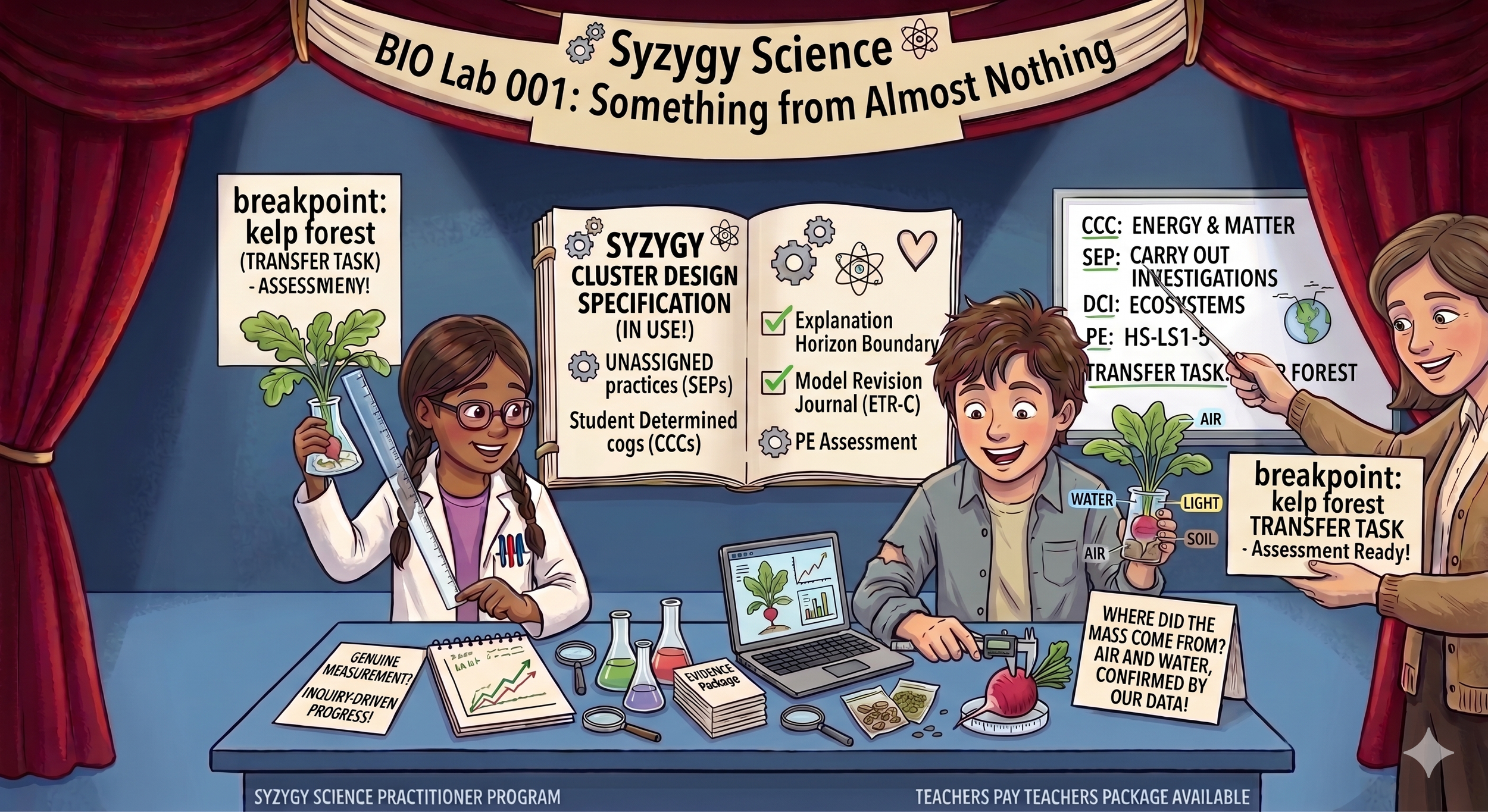
The posts on this blog have made the case for building NGSS materials from the ground up rather than retrofitting existing labs with dimension labels. Crosscutting concepts, science and engineering practices, and disciplinary core ideas are not a checklist applied after the fact. They are the structure of the inquiry itself. A lab that assigns them as a final step produces something that looks like three-dimensional learning without being it. At its worst, it produces what I have called Science Pantomime: students moving through the motions of investigation without genuine inquiry.
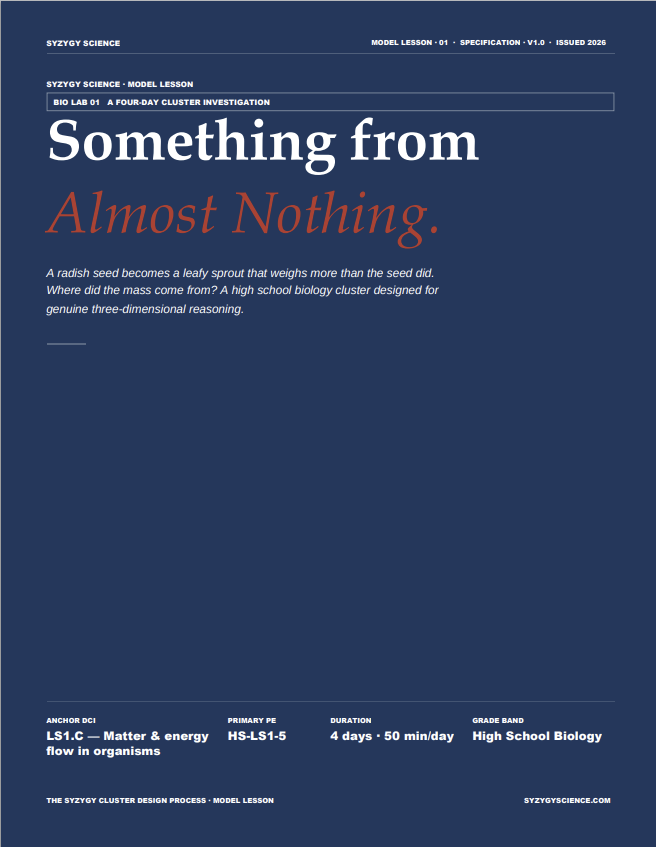
Syzygy Science BIO Lab 001: Something from Almost Nothing is a 47-page lab with supporting materials for NGSS-designed inquiry-based learning, now available on Teachers Pay Teachers.
BIO LAB 01 is my first public attempt to move past the critique and take it outside my own classroom. The question driving it was straightforward: can a classroom lab give students a genuine investigation, one where the thinking is theirs and the outcome is not predetermined? Most lab design starts from the content and works backward to the activity. This one started from the inquiry and asked what conditions would have to be true for students to do real investigative thinking inside a classroom. That is a different starting point and it produces a different kind of learning experience.
The phenomenon is a radish seed on a damp paper towel with nothing added but water and light. Students watch it germinate, put out leaves, and grow. At the end, the plant weighs more than the seed and all the water added to it combined. Where did the mass come from? Students who arrive knowing the word photosynthesis find quickly that vocabulary is not the same as understanding. The reasoning required goes deeper: tracing matter through a system, distinguishing it from energy, accounting for evidence that complicates the model rather than confirming it.
The lab operates within the three-dimensional framework, and many of its conditions are deliberately set. What students bring to those conditions is their own. Within the inquiry phase, they choose which crosscutting lens to apply and which evidence to examine. They are free to explore ideas, challenge what they thought they knew, and make mistakes. The focus is on their reasoning, not their conclusions. The downstream PE Assessment, set in a scenario students have not seen, is where that reasoning gets assessed.
This is the first in a series of labs and models, each designed to encourage rigor and genuine inquiry from the start. Some will be built on the Syzygy Cluster Design Process. Others will use different models suited to different learning experiences, but built on the same commitment to inquiry that is rigorous and student-driven rather than scripted.
The complete lab is available on Teachers Pay Teachers. The Syzygy Cluster Design Overview and the first few pages of BIO LAB 01: Something from Almost Nothing are here on the site. There are two ways to stay connected as the series develops. Adding your email to the mailing list keeps you informed as new labs and models are released. The Practitioner Program, coming soon, goes deeper: early access to design documentation, pre-release materials, and upcoming digital products for educators who want to engage with the framework directly.
