
Championing Uncertainty
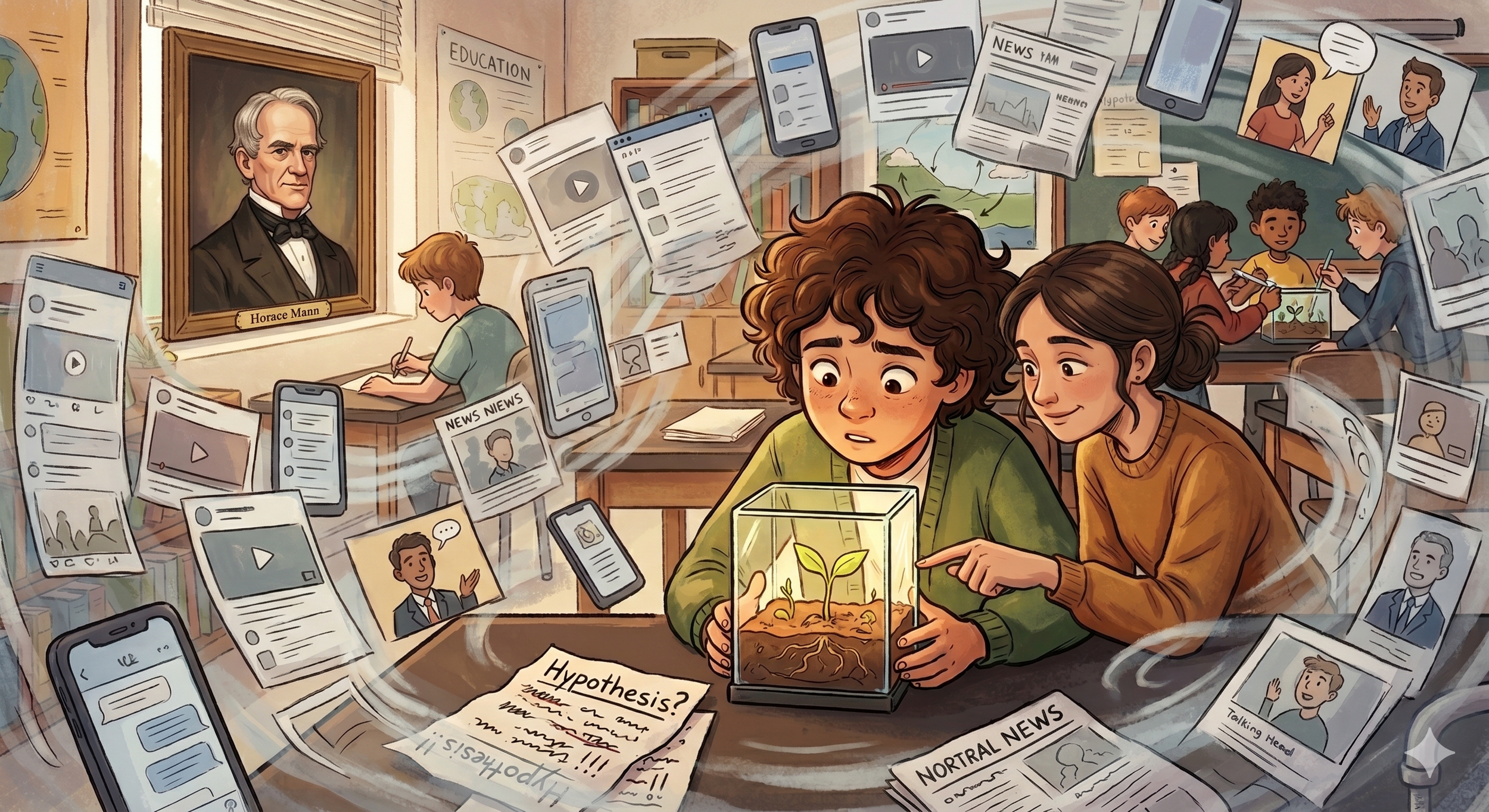
Students now move through an environment where a scientific paper, a conspiracy theory, a manipulated image, and a three-second video appear side by side in nearly identical formats. Everything arrives flattened. The distinction between evidence and assertion begins to erode because the delivery system treats both as equivalent forms of content.
How Inquiry Can Save Education
When Horace Mann helped build the American common school system in the nineteenth century, the problem he was trying to solve was straightforward. Knowledge was scarce. Access to it depended heavily on wealth, geography, social class, and circumstance. A democracy could not function well if education remained concentrated among the few people who had the time, resources, or institutional standing to acquire it. Mann’s argument was both civic and practical: an informed citizenry required a public institution capable of distributing knowledge broadly and reliably.
The schools he helped create reflected that reality. They standardized curriculum, trained teachers, organized classrooms, and built systems capable of transmitting information at scale. In a world defined by scarcity, that made sense. If knowledge is difficult to access, then education becomes a distribution problem.
Underlying the system was an assumption that seemed reasonable at the time: knowledge and discernment would develop together. Teach students history, mathematics, science, and literature, and sound judgment would emerge alongside factual understanding. Mann had little reason to question that assumption. In a world where information itself was scarce, ignorance was often the primary obstacle to good reasoning. You cannot think carefully about ideas you have never encountered. Before discernment could become a civic expectation, access had to exist first.
The system worked remarkably well. Public education expanded literacy, civic participation, and access to knowledge across entire populations. The institution succeeded at the mission it was built to accomplish.
The promise of modern technology was universal access to knowledge. Information would no longer belong primarily to universities, libraries, experts, or the wealthy. Nearly everything could exist within reach of anyone carrying a phone. From our current vantage point, however, the deeper problem is easier to see. Human beings were never meant to process information at this scale or speed, especially once information became entangled with outrage, ideological agendas, advertising, half-truths, manipulation, and algorithmically amplified distortion. Scarcity did not disappear into balance. It inverted into saturation.
The transition happened slowly enough that institutional education never experienced a clear moment of reckoning. Schools adapted where they could. Students were taught media literacy, source validation, CRAAP, SIFT, and other evaluative frameworks intended to distinguish credible information from unreliable claims. Those strategies helped for a while, but they were eventually overwhelmed by the scale and sophistication of algorithmically generated and curated content.
The architecture of modern schooling was not designed to cope with information saturation because it was built for a world defined by scarcity. Students now move through an environment where a scientific paper, a conspiracy theory, a manipulated image, and a three-second video appear side by side in nearly identical formats. Everything arrives flattened. The distinction between evidence and assertion begins to erode because the delivery system treats both as equivalent forms of content.
Political polarization, institutional failures, and decades of anti-intellectualism blurred the distinction between expertise and opinion even further. Evidence-based claims and personal conviction increasingly began occupying the same rhetorical space. Artificial intelligence accelerated the instability by making convincing text, images, audio, and video extraordinarily easy to generate. The result was not healthy skepticism so much as a weakening of shared standards for determining what counted as knowledge in the first place.
The algorithm intensified these conditions not because it was designed to deceive people but because it was designed to hold attention. Engagement increasingly favored outrage, fear, validation, tribal loyalty, novelty, shock, and emotional intensity over patience or reflection. Careful explanations moved too slowly. Nuance struggled to compete with certainty. Incremental understanding could not keep pace with emotionally satisfying conclusions delivered instantly and reinforced continuously. The problem became larger than misinformation alone. Over time, attention itself began to erode.
This changed the teacher’s role in ways schools were never designed to handle. Teachers were no longer competing only with distractions. Many students had arrived with conclusions before the lesson had even begun. The platforms shaping those conclusions rarely required them to remain uncertain, test an idea carefully, or stay with a difficult question long enough for genuine inquiry to occur. The sensation of knowing often arrived before the experience of finding out.
Learning Requires the Willingness to Be Wrong
Schools, often unintentionally, reinforced many of the same habits. If the visible goal of education is producing correct answers, then wrong answers become something students learn to avoid rather than examine. The reward structure favors performance, speed, and confidence. Reasoning becomes secondary because reasoning is difficult to measure and often slow to reveal itself.
You can see the consequences in ordinary classroom moments. Ask students to explain something before they know the answer, and many immediately become cautious. Some want reassurance that they will not lose points for being wrong. Others wait silently for someone else to speak first. Uncertainty no longer feels like part of learning. It feels like exposure.
The instinct is understandable. Most systems surrounding students reward immediate certainty and penalize visible error. But genuine learning has always depended on revision. Nearly every meaningful intellectual advance began with an explanation that eventually failed under pressure from evidence or experience. That is not a flaw in the process. It is the process.
Schools sometimes invert that relationship. Incorrect answers become deductions before they become opportunities for investigation. Students learn to protect themselves from being wrong instead of using wrongness productively. Over time, many become skilled at performing understanding while avoiding the vulnerability genuine inquiry requires.
That vulnerability matters more now than it once did. With genuine inquiry, the classroom changes. Students working in groups begin identifying tensions within a phenomenon and discussing why those tensions matter. Someone offers an explanation. Someone else notices a contradiction. The group adjusts. Another idea survives a little longer. For a period of time, nobody knows the answer, and that uncertainty stops feeling threatening.
Over time, understanding stops feeling like information delivered by authority and starts feeling like something students helped build themselves. Knowledge no longer feels like information to memorize, but understanding they participated in constructing.
A real investigation asks students to do something algorithms are not designed to support. It asks them to remain uncertain long enough for observation to matter. It asks them to distinguish between what feels convincing and what survives testing. It asks them to revise their thinking without experiencing revision as humiliation.
The satisfaction that comes from this process differs from the satisfaction produced by instant answers and endless streams of content. A student who has watched an explanation fail, revised it, tested it again, and arrived at something more durable experiences understanding differently. It feels earned.
Mann built schools to solve the problem of informational scarcity. We now live under the opposite condition. Information is abundant, immediate, emotionally optimized, and frequently detached from reliable standards of verification. Under those conditions, the central challenge of education is no longer simple access to knowledge. It is helping students remain thoughtful inside overwhelming informational abundance.
That requires something schools have often struggled to reward: the willingness to remain uncertain long enough to think carefully. Education may now have to recover something deeper than information delivery. It may have to rehabilitate uncertainty, revision, and intellectual vulnerability as ordinary human experiences rather than conditions to escape as quickly as possible. Because in Mann’s world, ignorance was the obstacle to citizenship. In ours, certainty may be.
