
Is NGSS Better Than Traditional Science Curriculum?
NGSS Isn't the Science We Know, It's the Science We Need
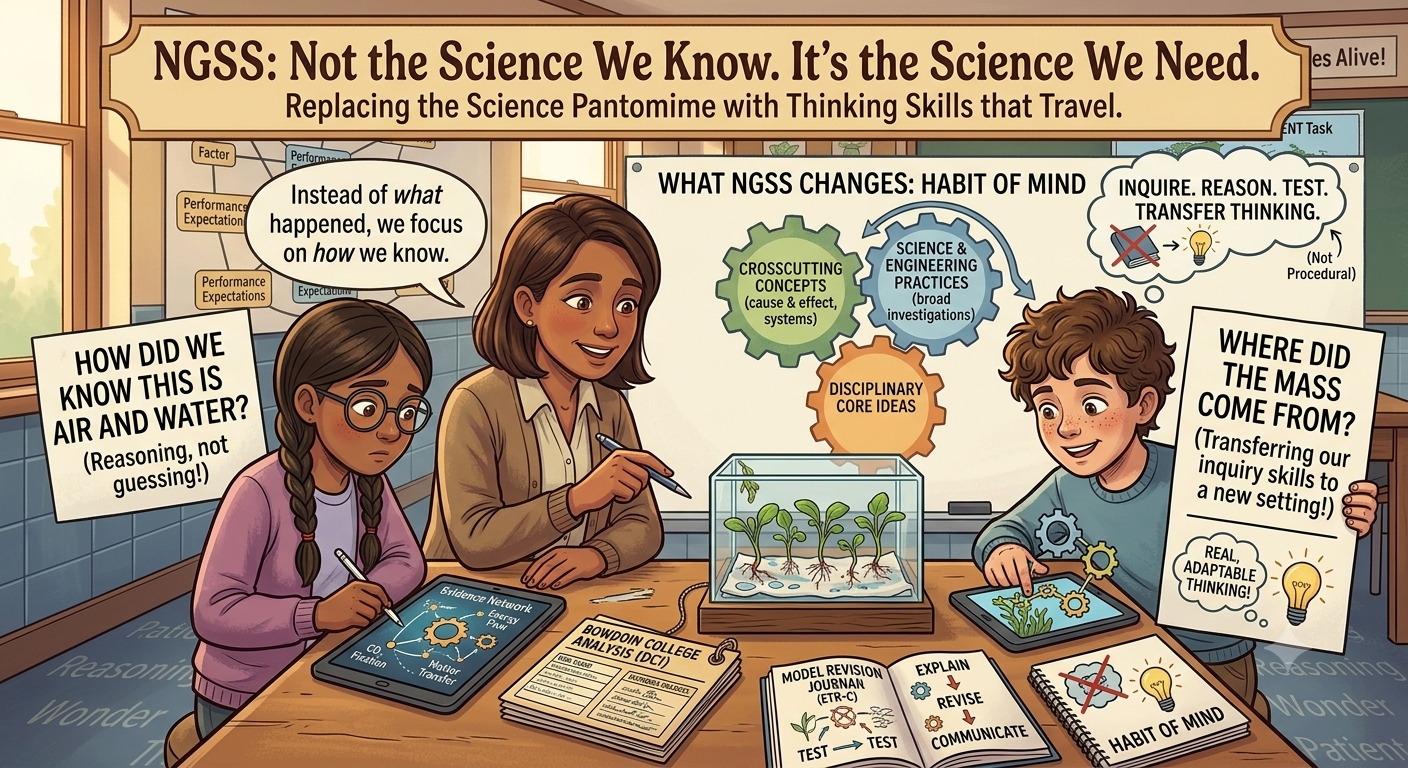
NGSS is a three-dimensional model of science education where process is as important as knowledge.
Science is not a collection of facts. It is a way of looking at the world, and that distinction changes everything about how you teach, how you learn, and what you are left with when science class is over. NGSS is built on that distinction. At its core it is a framework for investigating phenomena, for taking something observable and asking what is actually going on. That process, observing, questioning, testing, situating what you find against what is already known, is not a laboratory skill. It is a thinking skill. And like any thinking skill, it travels. A student who has genuinely learned to investigate a phenomenon in a science classroom does not stop doing that when they leave. They carry it with them.
For most of the history of science education in this country, the goal was knowledge acquisition. Students learned the names of things, the stages of processes, the steps of procedures. The measure of success was whether they could reproduce that information accurately on a test. This produced students who were good at short term retention and poorly equipped for science reasoning.
The scientific method, as most of us learned it, is a version of this problem. It is presented as the way scientists investigate the world: ask a question, form a hypothesis, design an experiment, collect data, draw a conclusion. It is clean, linear, and easy to assess. It is also a simplification that bears limited resemblance to how science actually works. Genuine inquiry is messier, more varied, and more iterative. Experimentation is one tool among many. Statistical analysis, modeling, comparative study, and collaborative peer review are all part of how scientific knowledge gets built. Teaching the scientific method as the dominant method produces students who know one narrow path through a much larger landscape. If science is a body of facts to be memorized and a single procedure to be followed, the job of a student is to receive and store information. There is no practice of questioning, no habit of testing, no framework for evaluating a claim that arrives from outside the classroom. Students learn to be encyclopedias rather than scientists.
NGSS addresses this by organizing science learning around three dimensions that work together rather than in isolation. The first is Crosscutting Concepts, which are patterns of thinking that apply across all scientific disciplines. These are ideas like cause and effect, systems and models, and the patterns. They give students a lens for looking at any phenomenon, in any domain, and asking the right kind of questions. The second is Science and Engineering Practices, which describe the full range of cognitive, social, and physical ways scientists actually investigate the natural world. This is far broader than any single method and includes things like analyzing data, constructing explanations, arguing from evidence, and communicating findings. The third is Disciplinary Core Ideas, which represent the cumulative body of established scientific knowledge, what we already know and understand, against which new learning has to be tested and situated. A student who encounters a new claim does not evaluate it in a vacuum. They ask how it fits with what science has already established, and where it conflicts, they ask why.
These three dimensions are meant to operate simultaneously, not sequentially. A student observing that plants near a window grow toward the light might, in a traditional lesson, be told this is called phototropism and asked to memorize the definition. In an NGSS-aligned lesson the same observation becomes the starting point for an investigation. The student uses crosscutting concepts to notice a pattern and ask what is causing it. They use science and engineering practices to design a way of testing their explanation. They situate what they find against the disciplinary core idea of how organisms respond to their environment. The content, the method, and the thinking pattern are all engaged at once, and the student arrives at understanding through the process rather than receiving it as a finished product.
This is also where NGSS is genuinely harder than traditional science education, for students and teachers alike. The old model offered certainty. There was a question and there was an answer, and success meant producing the answer. NGSS asks students to work through uncertainty, to treat not knowing as the beginning of a process rather than evidence of failure. A student might spend an entire class period investigating something and arrive at a conclusion that turns out to be incomplete or incorrect. In a traditional classroom that would feel like falling short. In an NGSS classroom it is the expected and necessary path. Being wrong is an inherent part of inquiry. It is the mechanism that moves investigation forward, and students who have only been trained to produce correct responses on demand find that reorientation genuinely difficult. It takes time and it takes a classroom culture that treats a revised conclusion as progress rather than admission of error.
NGSS also asks teachers to hold two things at once. Content still matters. A student who moves through an inquiry process and arrives nowhere, who cannot connect what they investigated to the established body of scientific knowledge, has not learned science. The process is what gets students to the content through genuine inquiry, and both matter equally. What changes is the teacher’s role. Rather than being the sole source of answers, the teacher becomes the person who knows the landscape well enough to guide students through it. That requires as much knowledge as traditional teaching, sometimes more, because the teacher has to know not just the answer but the terrain around it, the likely wrong turns, the productive questions, the moments when confusion is generative and the moments when a student needs to be redirected. Science teachers, perhaps more than any other group, are already inclined to examine their own practice, and the ones who teach this way successfully are not exceptional. They are teachers who understood that their job was never to be an encyclopedia. It was to build scientists.
A reasonable skeptic might point out that education has seen reforms before. Pendulums swing, and what looks essential today gets replaced by something else in a generation. That is probably true of NGSS as well, and it is not a reason to dismiss it. It is a reason to understand what teach8ng modles do. We now have tools that would have been unimaginable to the people who designed the first science curricula. Artificial intelligence, large language models, and collaborative technologies are already changing how knowledge is produced and how it circulates. Whatever comes next in science education will need to reckon with those tools. A student who has learned to investigate, reason, and test claims against evidence is better prepared for that future than one who memorized the right answers is less prepared when information is ubiquitous. NGSS is a step, not a destination. Like science itself, it is a framework still under development, one that teaches students how to rationally investigate the world rather than simply handing them answers.
There is a version of science class that looks right and produces nothing. Students move through the lab, fill out the worksheet, arrive at the expected result, record it correctly, and receive full marks. None of it required them to think. This is science pantomime, the performance of inquiry without the substance of it, and it is the thing NGSS is designed to make harder to do. Real science is not a right answer on a test. A student who finishes a science class knowing how to examine their own reasoning, revise their thinking when the evidence demands it, and push their understanding further has learned something that will outlast any fact they were asked to memorize
If this is the case you needed for why NGSS matters, the Framework Overview shows what it actually looks like to design a lesson this way, three dimensions engaged at once instead of bolted together after the fact.
