
 Image 1 of 1
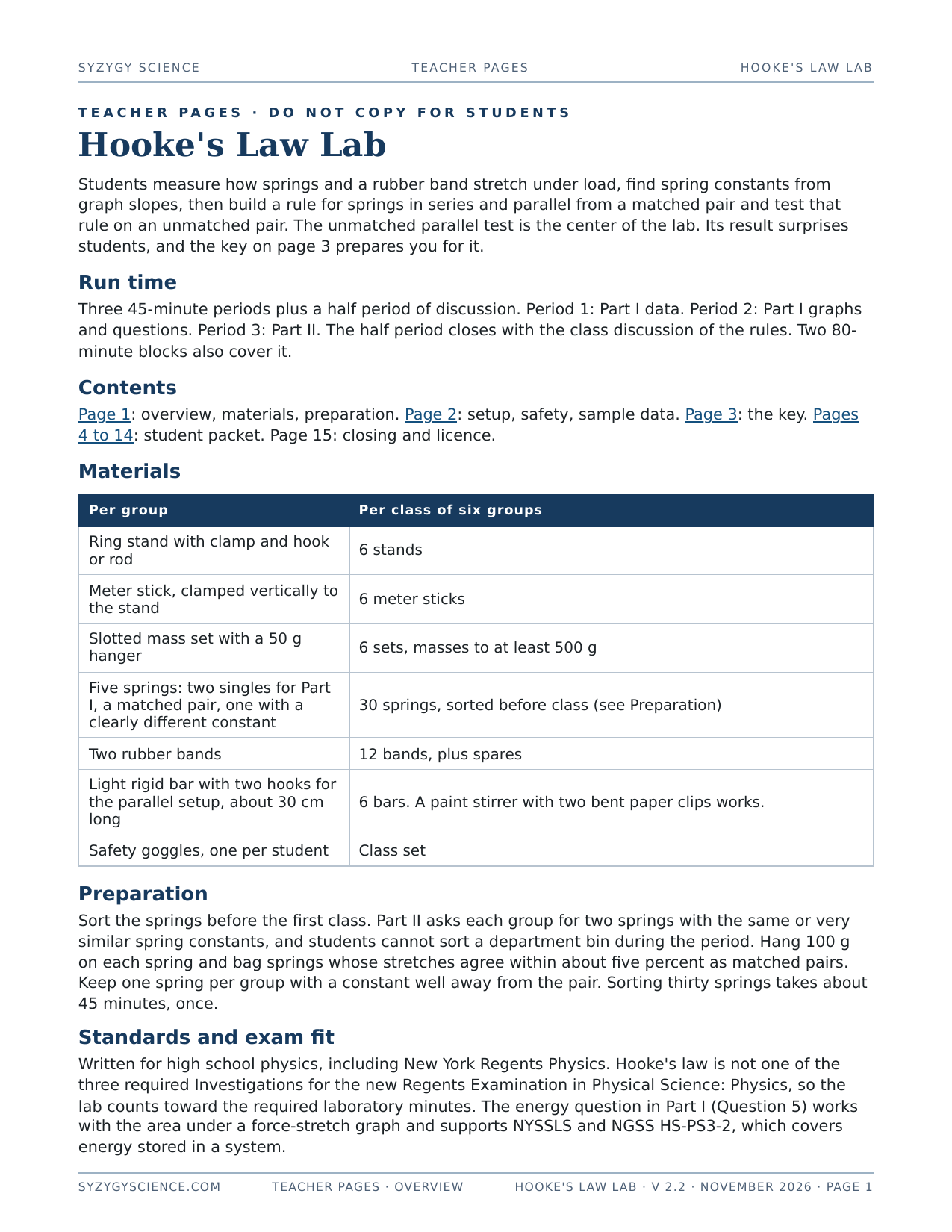
A spring stretches in proportion to the force applied to it, and the slope of a force-stretch graph is the spring constant. In this lab, students measure that constant for two springs, a series pair, and a rubber band. Then they build a rule for springs in series and parallel from a matched pair of springs, and test the rule on an unmatched pair. The unmatched parallel test produces a result that surprises every class, and the teacher key explains the physics behind it and how to run the discussion it starts.
This lab is free.
Exam target and standards: written for high school physics, including New York Regents Physics classes working toward the Regents Examination in Physical Science: Physics. Hooke's law is not one of the three required Investigations for that exam, so this lab counts toward the required laboratory minutes. The energy question in Part I supports NYSSLS and NGSS HS-PS3-2.
Run time: three 45-minute periods plus a half period of discussion. Two 80-minute blocks also cover it.
What students do: Part I, measure two springs, a series pair, and a rubber band across five loads each, graph force against stretch on printed grids, and answer five questions, including one on the energy stored in a stretched spring. Part II, collect data for a matched pair of springs alone, in series, and in parallel, state a general rule for each arrangement, then repeat the measurements with an unmatched pair and report whether the rules held.
Equipment, per group: ring stand with clamp and hook, meter stick, slotted mass set with a 50 g hanger, five springs (two singles, a matched pair, one with a different constant), two rubber bands, a light rigid bar with two hooks for the parallel setup, and safety goggles. The teacher pages include the preparation that sorts the class springs into matched pairs before the first class.
The key covers: answers to all five Part I questions, sample data with expected spring constants for typical school springs, the series and parallel rules for a matched pair, and a full treatment of the unmatched parallel result, including the constant a class will measure with the load at the middle of the bar and the condition under which the constants add.
What is inside (one PDF, 15 pages):
Pages 1 to 3, teacher pages: overview and run time, materials and preparation, setup notes, safety, sample data, and the key.
Page 4, Part I instruction: the introduction, the graphing instruction, the procedure, the safety box, and the series prediction.
Page 5, Part I data table: five loads, with position and stretch columns for all four cases.
Pages 6 to 7, Part I graphs: one printed grid per case, with slope work space.
Pages 8 to 9, combined graph, the five questions, and the Part I discussion with its scoring rubric.
Page 10, Part II introduction and Figure 1, with Experiment 1, the matched pair.
Pages 11 to 12, Experiment 1 data tables, graph, and the general rules.
Pages 13 to 14, Experiment 2, the unmatched pair: data tables, graph, and the closing discussion with its scoring rubric.
Page 15, closing and licence.
Companion lab: PHY Lab 001, Not All Springs Are Springs ($4), takes springs and rubber bands into energy storage and energy loss, with loading and unloading cycles and a bungee cord assessment. This free lab builds the spring constant and the series and parallel rules that PHY Lab 001 uses.
Version 2.2, November 2026. Version 2.2 adds the teacher pages and the key, rebuilds the Part I data table, prints data tables for Part II, redraws the series and parallel figure, and corrects the opening definition of Hooke's law.