
 Image 1 of 1
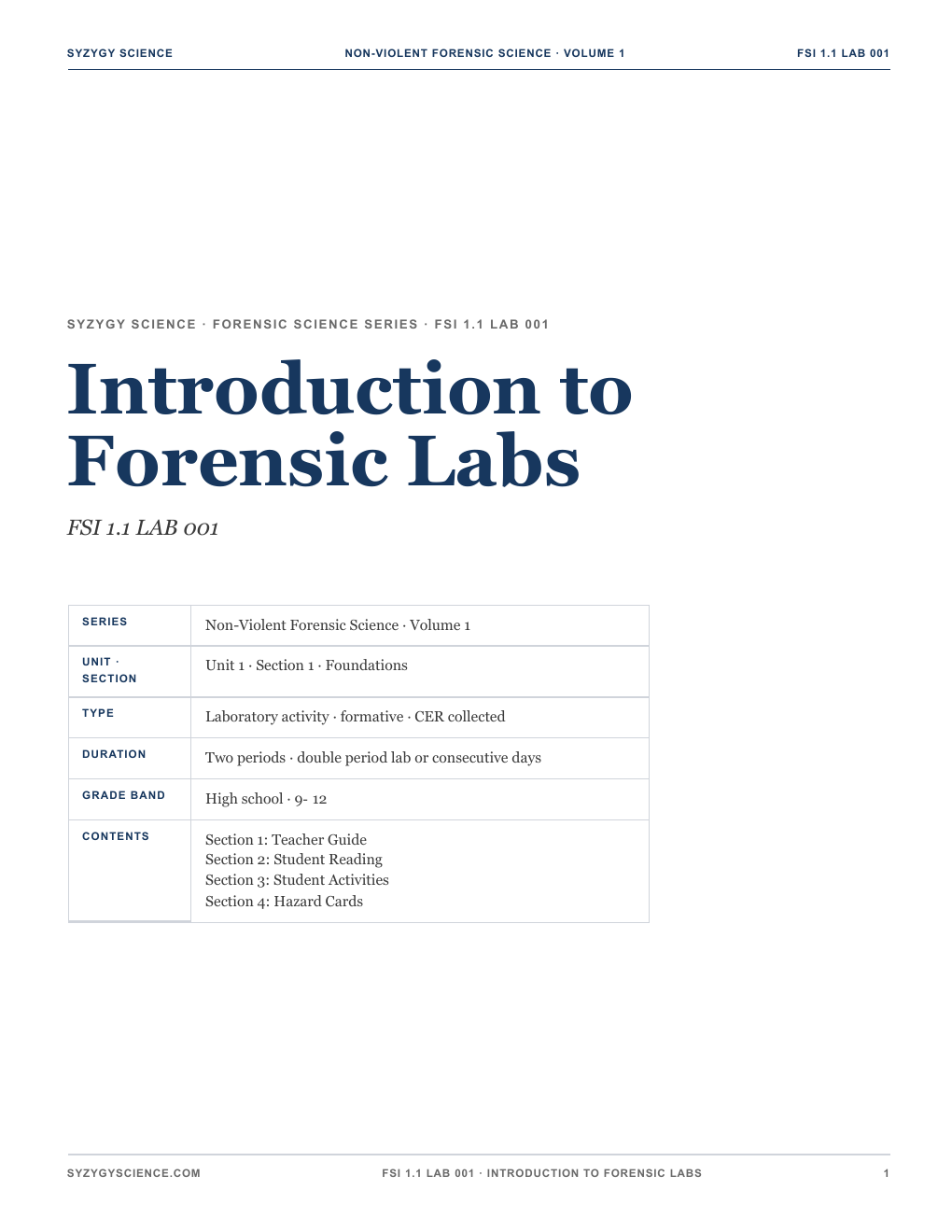
Introduction to Forensic Science Labs: Evidence and Hazards | FSI 1.1 LAB 001
A forensic trace evidence analyst and a high school chemistry student each leave a sample container unsealed. One mistake ruins a case. The other teaches the discipline that prevents it.
Why is this lab built differently
Most forensic labs teach safety as a list to memorize. This lab treats containment, documentation, and hazard response as the work itself. Students earn the right to run a simulated chain of custody by proving that they can protect evidence, label it precisely, and respond correctly when a scenario turns unsafe.
The three dimensions are structural. Every activity originates in the Next Generation Science Standards three-dimensional science learning model, which defines scientific knowledge by combining science and engineering practices, disciplinary core ideas, and crosscutting concepts. Students do not collect procedures. They reason from practice, content, and pattern at the same time.
The series is non-violent by design. Nothing here depends on blood, bodies, or violent crime. The hazards are real, chemical, and electrical, and the stakes are professional.
The lab is the first in the Non-Violent Forensic Science series, created for students who are drawn to investigation and the laboratory sciences without being drawn to the gore.
What students do:
- Handle simulated trace evidence under controlled contamination scenarios
- Complete a contamination source map using real facility scenarios, linking facility zones to the types of contamination they produce, and then complete a facility improvement plan. Students identify a contamination source, propose a mitigation, and evaluate its trade-offs.
- Design and justify a PPE and hazard response plan using the hazard scenarios and the PPE Decision Matrix provided.
- Assemble a legally defensible evidence log and chain of custody record, then decide how to document and explain evidence that has been compromised.
- Perform a chemical hazard identification task, using the lab inventory and GHS hazard statements to classify substances and determine the correct storage, labeling, and emergency response for each.
- Document a chemical spill scenario with a formal incident report.
Standards:
- NGSS Science and Engineering Practices: Asking questions and defining problems (HS-ETS1-1), Constructing explanations and designing solutions (HS-ETS1-3)
- NGSS Disciplinary Core Idea: ETS1.B: Developing Possible Solutions
- NGSS Crosscutting Concept: Systems and System Models
- Common Core ELA: RST.9-10.3, RST.9-10.4
What's included:
Section 1: What is forensic science? (Pages 3-4)
Section 2: The Three Dimensions of Scientific Thinking (Pages 5-6)
Section 3: Evidence, Contamination and the Chain of Custody (Pages 7-11)
Section 4: Hazards, PPE and the Emergency Response (Pages 12-17)
Section 5: Lab: Evidence Control and Contamination (Pages 18-27)
Section 6: Lab: Hazards and Emergency Response (Pages 28-32)
Section 7: Evidence, Ethics and the Law (Pages 33-35)
Answer Key: (Page 36)
This lab requires two teaching days and is designed for the general science classroom, the dedicated forensic science classroom, and the pre-university laboratory. Every page is print-ready, with room for students to draw, annotate, and document their work.