
 Image 1 of 2
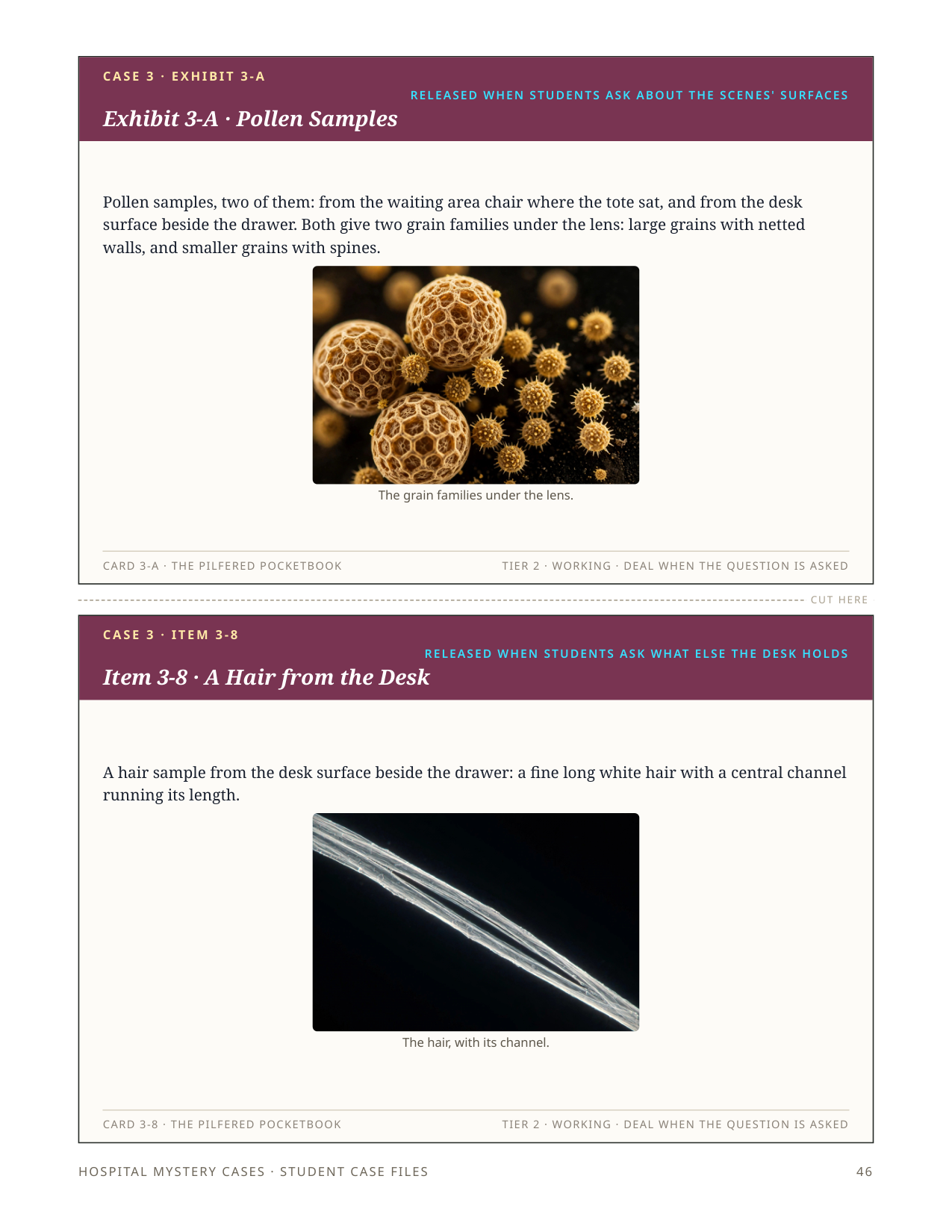 Image 2 of 2
The case — Across the hospital's open house day, four visitors lose their property, each in a crowded room and each in the minutes its owner stepped away: a wallet from a tote at 11:20 AM, a purse from the main hall bench at 1:15 PM, a pocketbook from the information desk's drawer at about 3:05 PM, and a second wallet from a coat at 4:40 PM. The staff search the rooms visitors use at the sale's close and find nothing. At 7:30 PM the security walk passes the old wing corridor, a service corridor visitors never enter, and records a fall of pale dust on the floor and a chair standing out of line.
The driving questions — Who took the items, and where are the items now?
What students do — Groups read the case file and the five interviews, then request evidence cards from the evidence keeper as their questions call for them. Every card carries its release condition in its header. Students read pollen grain families from two scenes against the panels in the Hospital Suspect File, examine a hair with a central channel and crystals from a drawer, work a reach from a ceiling height of 2.45 m and a chair's seat, and read the old wing corridor's dust record: an unbroken film, one tile out of true, and a partial print in the dust fall. The claim page asks the two questions separately, and it asks for the claim, the evidence that supports it, the reasoning that joins the lines, and the strongest counterclaim.
What is included — 1. Case file: Hospital-Case-Three-The-Pilfered-Pocketbook-SINGLE-v4-2026-11-21.pdf, 19 pages. The case divider and case file, the suspects page, the five interviews on one page, 14 evidence cards, the evidence log, the claim page, and the case's teacher pages: the If They Ask facilitator guide, the solution, and the interview claim key. 2. Hospital Suspect File: Hospital-Suspect-File-Profiles-1-9-v4-2026-11-21.pdf, 41 pages. All nine hospital suspect profiles as its own file. This case draws on five of the nine. 3. Support Slides deck for this case, with the evidence cards as slides, and its Access Sheet carrying the Google Slides force-copy link.
Google Slides access — Open the Access Sheet and follow the printed link. Google Slides offers a copy of the deck, which saves to your Drive. The deck file in the download is the backup copy of the same deck. The slides are images, so the text on a slide cannot be edited.
Printing and setup — Print the case pages once for each student, without the evidence card pages. Print the evidence card pages once for the keeper and cut each page on the dashed line. Print the Hospital Suspect File once for each group. Print the teacher pages once, for the teacher only. A student evidence keeper holds the cards and releases each card when a group's questions call for it. The case runs in one to two class periods.
Part of the pack — This single case is one of the three cases in the Hospital Mystery Cases. The full pack is sold separately as the Hospital Super Pack. This download carries the complete Hospital Suspect File as its own file, so the case runs on its own.
Standards note — Forensic science has no formal NGSS performance expectation set. The teacher pages give the If They Ask guide and the solution for this case, and the Super Pack's Teacher Pack gives the grade band, the assembled expectation, and the alignment by practice for the set. The work is nonlinear and inquiry-based: students build the account of the day from evidence they request, log, and weigh.