
 Image 1 of 1
The Museum Gala Mystery Cases | Super Pack
The cases
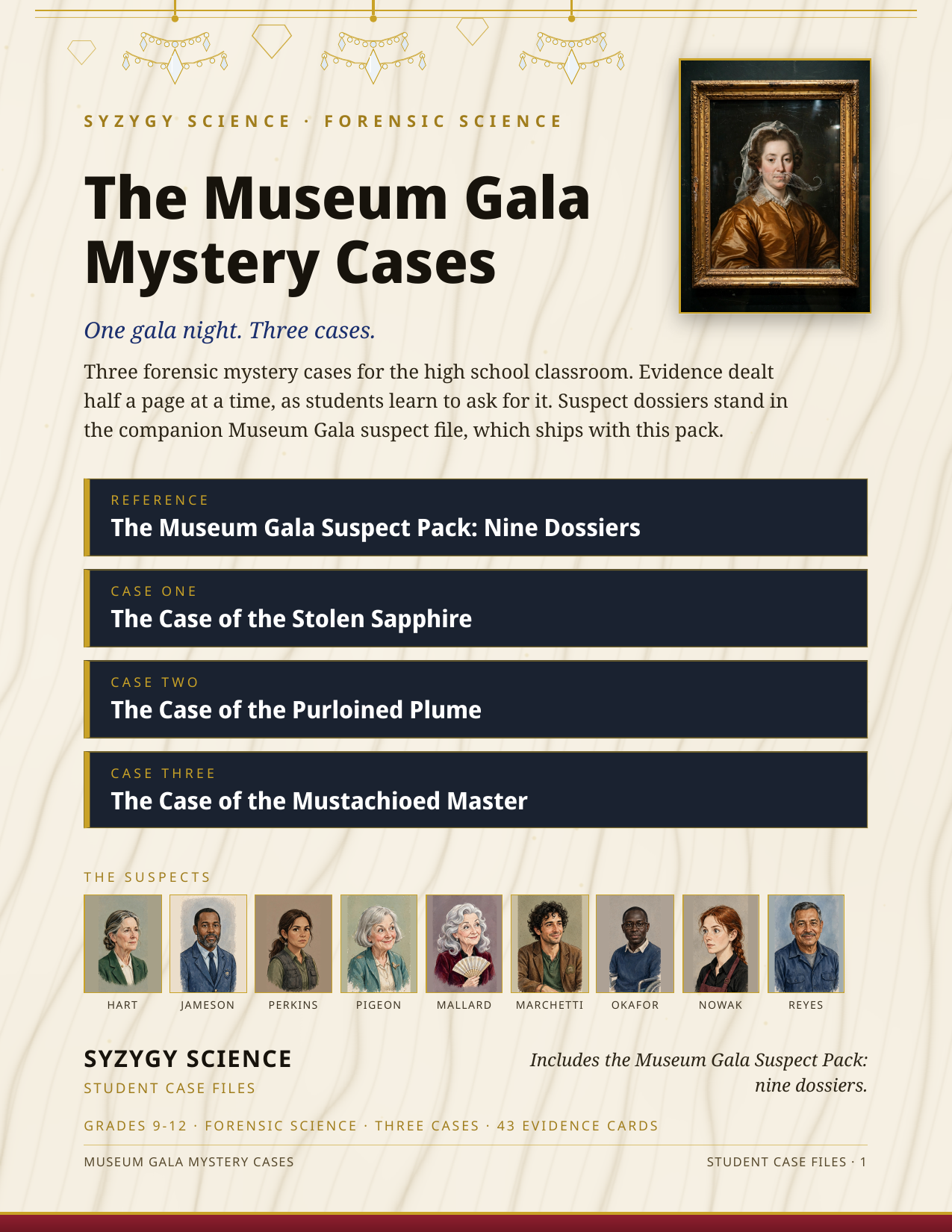
One gala night at the Museum of Antiquities. Three cases share the night, the building, and a cast of nine suspects. In Case One, the Midnight Sapphire is unveiled at the gala, and by the time the alarm sounds its case is broken and the gem is gone. In Case Two, the Plume of Perfection vanishes from its case during the costume gala in the Hall of Birds, and a peacock feather is found taped to a champagne bottle behind the bar. In Case Three, the loan portrait "The Amber Duchess" is found in the morning with a handlebar mustache etched into its cover glass, the painting beneath untouched.
The driving questions
Who took the Midnight Sapphire, and how was it done?
What happened to the Plume of Perfection, and who is responsible?
Who etched the mustache on "The Amber Duchess," and what actually happened to the glass?
What students do
Each case runs on its own and the cases run in any order. Groups read the case file and the interviews, then request evidence cards from the evidence keeper as their questions call for them. Each card is logged before it is used. Students work from the shared Suspect Dossier: fingerprint records, handwriting samples, trace panels, shoe prints and tracks, DNA records, and carried items. Each case closes on a claim page that asks for the claim, the evidence that supports it, the reasoning that joins the lines, and the strongest counterclaim. The three cases hold 43 evidence cards in total: 15 in Case One, 14 in Case Two, and 14 in Case Three.
What is included
The download is one ZIP holding the full set:
1. Complete Pack, 75 pages. The student pack and the teacher pack in one file, in pack order.
2. Student Pack, 58 pages. The shared front matter and reference pages, all three case files with their suspects and interviews, all 43 evidence cards, the evidence logs, and the claim pages.
3. Teacher Pack, 17 pages. Running the cases, grade band, standards, and prerequisites, the If They Ask facilitator guide, the solution, and the interview claim key for each case, the visuals and records pages, and Scoring the Claim Pages.
4. Suspect Dossier, 41 pages. All nine Museum Gala suspect profiles, as its own file, printed once for each group.
5. Teacher-side evidence key, 14 pages. The formatted key for the Museum pack, profiles 032 to 040, for the teacher only.
6. Support Slides companions: a keeper deck for each of the three cases, with the evidence cards as slides, each with its Access Sheet carrying the Google Slides force-copy link and a QR code. A combined companion deck holds all three cases' evidence cards in a single file.
7. Case videos: a case introduction video for each of the three cases, played to open the lesson. A combined pack video introduces the three cases together.
The three cases are also sold as singles at $8 each. Each single carries its own Student Case File, Teacher Edition with the teacher-side evidence key file, the Suspect Dossier, its Support Slides deck and Access Sheet, and its case video.
Google Slides access
Open a case's Access Sheet and follow the printed link. Google Slides offers a copy of the deck, which saves to your Drive. The Support Slides deck file in the download is the backup copy of the same deck. The slides are images, so the text on a slide cannot be edited.
Printing and setup
Print each case's case pages once for each student, without its evidence card pages. Print the evidence card pages once for the keeper and cut each page on the dashed line. Print the Suspect Dossier file once for each group; one class set serves all three cases. Print the teacher material and the teacher-side evidence key once, for the teacher only. A student evidence keeper holds the cards and releases each card when a group's questions call for it. Each case runs in one to two class periods.
These Museum Gala cases are the full cases: 43 evidence cards across the three cases, the full interviews, and the complete nine-profile Suspect Dossier.
Standards note
Forensic science has no formal NGSS performance expectation set. The Teacher Pack gives the grade band, the alignment by practice, and the prerequisites for the cases. The alignment names nonlinear inquiry-based learning: students build the account of the night from evidence they request, log, and weigh, and the second paragraph of a case's work is the claim they defend at the reveal.